This paper was submitted as part of the honours program at Curtin University in 1995, and designed for distribution within the professional artists community.
No such thing as a free lunch
Graham Hay
November 1995
Abstract
In his criticism of the ideological consequences of the state funding of the arts, Gough (1995) omitted special-interest groups and showed no awareness of the economic links between community and professional markets. In contrast, corporatism theory stipulates that shared ideologies are a precondition for negotiated exchanges between the state and arts. These exchanges produce the funding system designed to foster community participation and artistic excellence by professional artists. Further application of the theory detected institutional causes of declining professional artists' real income and state sponsorship of the arts. In response, this paper recommends greater attention to the links between the quantity aspects of professional arts training and incomes.
Democracy is the key to cultural value...
(Creative Nation, 1994, p. 1)
I think the job of democracy in the field of art,
is to make the world safe for elitism.
Robert Hughes (cited in Slattery, 1995, p. 23)
November 1995
Abstract
In his criticism of the ideological consequences of the state funding of the arts, Gough (1995) omitted special-interest groups and showed no awareness of the economic links between community and professional markets. In contrast, corporatism theory stipulates that shared ideologies are a precondition for negotiated exchanges between the state and arts. These exchanges produce the funding system designed to foster community participation and artistic excellence by professional artists. Further application of the theory detected institutional causes of declining professional artists' real income and state sponsorship of the arts. In response, this paper recommends greater attention to the links between the quantity aspects of professional arts training and incomes.
Democracy is the key to cultural value...
(Creative Nation, 1994, p. 1)
I think the job of democracy in the field of art,
is to make the world safe for elitism.
Robert Hughes (cited in Slattery, 1995, p. 23)
INTRODUCTION
This paper is designed to satisfy the requirements of an Honours degree and, through its circulation within the arts community, create a greater appreciation of the positive impact of professional associations on artists' incomes.
This paper is the outcome of a search to find an adequate theory to contextualise an experiential knowledge of the arts, and to critically evaluate Gough's (1995a) paper "The Faustian bargain: Government sponsorship of the arts" in Agenda, Volume 2, Number 2, pages 159-167 (copy in Appendix.1). Corporatism is superior to pluralism, and pure elitism theories, in explaining the artist-state relationship, a relationship which Gough criticises for being detrimental to artists. Corporatism's strength lies in emphasising the importance of the relation between groups and the state to explain political and economic outcomes. The examples chosen for specific exploration are inter-art form relationships, funding policy, arts ideology, and membership.
For the purposes of this paper, “state" is used very loosely in reference to both the Commonwealth and State governments, as, for all intents and purposes, they work together but at different levels. The arts in Western Australia, including the Western Australian Department for the Arts (WADFTA), annually receive over $3.3 million from the Australia Council (Australia Council, 1994, p. 113), and the Australia Council is legally required to take into account "the policies of State Governments, . . . so far as it is practicable to do so" (Australia Council Amendment Bill 1988 (enacted in 1991), Section 12-13).
Special interest groups are defined as registered, membership-based, non-profit organisations dedicated to promoting and protecting the interests of a specific group of people or cause. They can range in size and purpose from the National Association for the Visual Arts to the Perth Potters Club. Within the Western Australian arts there are approximately 2,000 such associations, councils or groups.
THEORETICAL considerations
We now turn to consider the various theoretical frameworks available within which to consider Gough's paper before focusing on corporatism. Underpinning Australian multicultural policy is pluralism, which argues that all cultural differences have validity and people can influence the neutral state simply by publicly indicating their political preferences in voting or joining a special interest group. These groups would modify the state's totalitarian tendencies by conveying these preferences to the state (Cawson, 1986, p. 13-19). Yet in the arts, pluralism does not adequately explain why fine artists, representing a smaller proportion of the population relative to the crafts (ABS, 1991, p. 5), receive preferential treatment by the state (WADFTA, 1993/94, p. 85).
Elitist theory focuses on a political class, which dominates society, and a political formula, or rhetoric, that guides and legitimates the elites' domination (Albertoni, 1985, p. x). Within the arts, the élite are those who control the institutional education, collection and promotion of artists and their work. The quest for an undefined "excellence" is the political formula. This theory proved valuable in explaining the apparent preferential treatment given to a small and select group in the arts (Hay, 1995a, p. 9-11), but was weak in explaining the nature of the dynamic relationships between elite controlled groups.
Neither of these theories successfully conceptualised the many special interest groups nor the differences in their ability to gain resources and influence state policy. Similarly, Gough's (1995a) paper completely omits these groups from his analysis thus ignoring the substantial financial support these groups also receive from the state. Consequently, this paper will focus on three important characteristics of the corporatism model: reciprocity of group-state relations; shared ideologies; and, monopolistic membership.
The important difference between pluralism and corporatism is that, while pluralism may involve the state undertaking extensive consultation with all groups, corporatism occurs when both the state and a small number of groups seek each other and negotiate the sharing of power from oppositional, functional positions but within shared ideologies (Grant, 1985, p. 3). Therefore, corporatism is associated with 'contractual exchanges' between the state and group élites, who are able to use various institutional resources and structures to ensure compliance by their members (Scholten, 1987, p. 4). Within these groups, various social and political rewards and sanctions are used to enable their élite to strategically mobilise, and use, their collective power to influence their relationships with the state and other groups. However, to do this, a degree of compulsory membership is needed to increase the élites' influence over its group members. The traditional model of this is compulsory unionism, but other groups appear to be able to exercise similar influence via the state granting the group a type of territorial monopoly within an occupation. Corporatism also focuses on the way special interest groups operate as governments in their own right, with internal hierarchies of organisation and policy development. Thus, their relation with the state contains inter-governmental aspects and a "fusion of the processes of interest representation and policy implementation" (Cawson, 1986, p. 18).
Gough's omission of these groups is not surprising because, historically, they and their leaders, are not open to public scrutiny and, therefore, academic documentation. However, corporatism provides an appropriate theoretical framework to examine these groups, within the general parameters of Gough's discussion of the relationships between society, patrons, artists and the state.
Closely aligned to corporatism theorists are those who examine consociationalism aspects of inter-group relations. Consociationalism concerns the relationships between subcultures that may be segregated and oppositional in nature, be it on social, economic, political or cultural grounds. These subcultures often share similarities in the way they have stable internal class and status structures, and unique but homogenous social values and ideologies. In addition, they have developed close knit élites within their associations, and influential networks within political parties, the civil service and institutions (Scholten, 1987, p. 4).
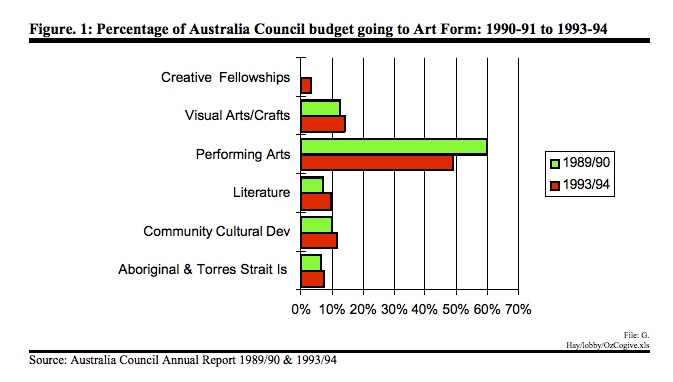
Differences in state funding of the various art forms indicate the relative ability of their subcultures to compete for grants. Based upon this perspective, Figure. 1 suggests that the performing arts subcultures appear to be experiencing a decline in influence (vis-a-vis other subcultures) and/or importance to the state. This is expected, given: that Australian performing arts is predominantly Euro-centric in nature; declining levels of European immigrants; and, the state's push to redefine Australia as a multicultural nation.
There are a number of substantial gaps within Gough's (1995a) critique, the largest being his omission of the role of arts lobby groups as agents operating between the arts and the state. In describing the national tribal links between politicians, arts media and the Australia Council, Gough (1995a) omits the important peak professional arts lobby groups such as Arts Action, Arts Voice, National Association for the Visual Arts (NAVA) and Craft Australia. These groups have been given, or acquired, art-form territorial monopolies corresponding to the funding categories used by the state. These monopolies of representation have a critical role in maintaining communication between artists and the funding administrators for that art form. They are also funded by the state or may operate as agents of state policy.
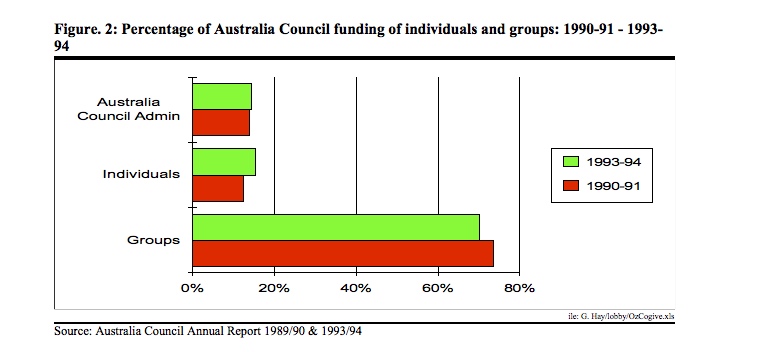
Special interest groups not only lobby the state on behalf of the Australia Council, they also lobby the Australia Council to fund themselves and their élite. Generally, these groups are very adept in negotiating "contractual exchanges" for continued and increased funding. Often, such élite groups receive a large 'bundle' of small grants from different categories making it difficult to identify them from the numerous small community group recipients. However, a clear increase in the proportion of total funding going to these groups, as illustrated in Figure. 2, does indicate that these groups are active within the arts in negotiating the art-state relationship to their financial advantage.
Special interest groups not only lobby the state on behalf of the Australia Council, they also lobby the Australia Council to fund themselves and their élite. Generally, these groups are very adept in negotiating "contractual exchanges" for continued and increased funding. Often, such élite groups receive a large 'bundle' of small grants from different categories making it difficult to identify them from the numerous small community group recipients. However, a clear increase in the proportion of total funding going to these groups, as illustrated in Figure. 2, does indicate that these groups are active within the arts in negotiating the art-state relationship to their financial advantage.
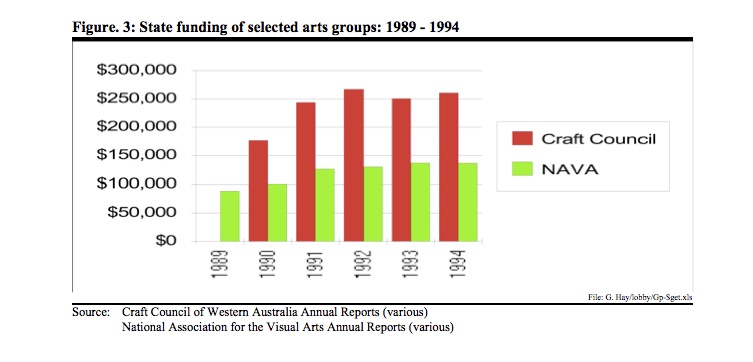
The increased funding of preferential groups, or arts agencies, is a negotiated exchange beneficial to both them, the WADFTA and the Australia Council. These arrangements enable a circumnavigation of state funding and staff limits, and the continuation of important but politically sensitive work. For example, the Labor government funded the Artist Foundation of WA to employ a public art officer, following a Trades and Labour Council's black ban on public art and a heated public meeting of artists. Figure. 3 indicates the financial scale of this type of creativity, with funding differences between the Crafts Council of WA (CCWA) and NAVA purely reflecting their relative ages. NAVA's inexperience is also indicated in that it sells information to the Australia Council (NAVA, 1994 Annual Report) rather than perhaps using it as a justification for its own involvement in policy development.
As these groups become more dependent upon recurrent state funding, they have a vested interest in aligning their activities more closely with the funding body's objectives. Alternatively, these negotiated transactions would not have occurred without similar ideologies. One way to guarantee these shared ideologies is by employing the same people: in the last six months the CCWA has 'poached' a Department for the Arts officer and NAVA has recently appointed a new Executive Director fresh from the Australia Council.
An Arts-state CONTRACT
Academic experience is a critical factor in the spread of shared ideologies, a necessary precondition for the emergence of arts-state "contractual exchanges". Berger defined academia as a class emerging as a result of changes that created the "knowledge industry" in society. Its members' social position rested upon "the manipulation of symbols rather than on the manipulation of things" (cited in O'Brien, 1978, p. 59-60). Like other groups, academia has developed its own self-justifying ideology, is internally stratified and headed by the "cultural élite", with a power centre in universities supported by publishing houses, periodicals and foundations. This group is closely linked to the communications media, as well as the welfare and regulatory arms of the state. In this, Berger shares Gough's awareness of the linkages between academia, the media and government departments, and demonstrates a distinct corporatism perspective. This group sees itself in a class struggle for power and privilege against the élite of the old business class ideologically opposed to capitalism and democracy (because like the business class, it is a minority). Many of these values still underpin current art theory and practise today. Gough (1995a) also identified similar avant-gardé forces seeking to generate a "fundamental transformation of society" (p. 163). These values incorporate a pessimistic social and environmental perception, justifying state intervention and expansion of employment and power for its members. As Berger (1978) pessimistically sums it up:
[t]he 'discovery' of every new group of deprived people in society legitimates the inauguration of programmes that benefit [][this group] - no matter whether they also benefit those on whose behalf the programmes are supposed to exist (O'Brien, 1986, p. 62).
As these views are prevalent among arts administrators, art group leaders and professional artists alike, who are predominantly tertiary educated, this suggests that universities are instrumental in creating common ideologies in the arts. The presence of a significant number of academics on national and state groups' elected committees reinforces this argument.
We will now briefly examine the history of national arts-state "contractual exchanges" in an endeavour to place Creative Nation in its proper perspective. Gough (1995a) is incorrect in implying that the state came "blundering into the field" only twenty years ago. In fact, the state established the Commonwealth Literary Fund to provide "pensions for needy writers" as early as 1908, and the early Australia Council for the Arts, established in 1968, was an advisory board (Australia Council, 1991, p. 9). That the state was willing to fund these activities suggests a receptive attitude that enabled artists' representatives not only to inform the state about the arts but also to gauge the general concerns and plans of the state, relative to its own needs.
The lobby for and creation of art legislation is a lengthy and costly process; the recent establishment of VI$COPY is a case in point. The key politicians, and their advisers, have to be dragged away from other lobby groups, day-to-day crises, the election cycle and administrative duties, to focus decisively on the proposal. Concurrent to this, the issue has to be canvassed, and massaged, down and up within the relevant departments and through the overlapping committees, without being stalled by party divisions. At the same time, the group represented has to be constantly informed so it doesn't fragment into conflicting opinions.
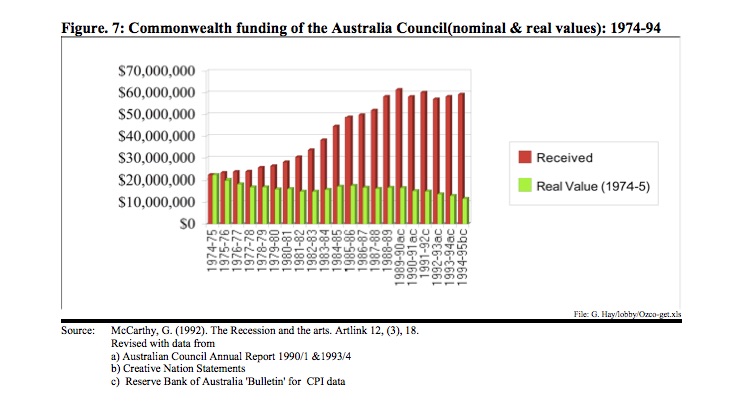
In a more general sense, legislation is a formal symbol of contractual agreements reached by the state and large groups of society. In tracing the history of the arts-state contract the key years are 1968-74, when the terms and conditions of the current Australia Council Act were negotiated prior to proclamation, and 1987-91, when a number of minor amendments to the Act were drafted and passed. The former period involved artists gaining a policy- formulating and grant-making statutory authority, which they partially controlled (see Australia Council Act, 1975, Section 9). The second period involved artists re-negotiating greater control over the statutory authority, with the amending Act specifically replacing state representatives on the Council with "community interest representatives" who: "(a) in the Minister's opinion, understood [...] the interests of the general community in relation to the arts; and (b) [are] not a professional artist [...]" (Australia Council Amendment Act, 1991, Section.2). This legislative distinction between community and professional artists is useful to keep in mind. Compared to these major legislative outcomes, Creative Nation was not a major event, did not signal a substantial increase in Australia Council funding (see Figure. 7) and was not rooted in law and so could be dismantled easily (Gough, 1995a, p. 164).
While Gough (1995a) alerts us to the unforeseen political implications of the contract, it is useful to summarise what were its original terms. Section 5 of the Australia Council Act (1975) stresses that the Council foster the personal awareness, appreciation and practise of the arts within the community. In addition, the Council was to publicise and reward artistic "excellence" and "the expression of a national identity". Thus, the Australia Council was designed to reverse a 'cultural cringe' about Australian culture and the loss of many of the most talented artists overseas. These contrasting democratic and élitist requirements underpin the inherent divisions of opinion within the arts on funding issues.
Unfortunately, these separate, private (artist expression) and public, (nationalistic) objectives have resulted in systems that allow the state to influence artistic content. In his article, Gough (1995) questions Phillip Adams' argument that Australian intellectuals' and artists' habitual larrikinism is proof that state sponsorship does not corrupt. Gough argues convincingly that, with the current "more purposeful drive towards national goals", intellectuals' and artists' ridicule has increasingly focused on the "Left's favourite targets" (p. 162-163). What Gough suggests is that, as a result of the current nature of state sponsorship of the arts in Australia, the arts community's ideologies swing toward the political party in power. He also argues that the blame does not rest solely with Labor, as a change in government would not "make any difference to the system of patronage" (p. 165). Similarly, Chomsky (1989) focuses our attention on the tendencies encouraged by the structure of the arts when, in examining political processes, he states that:
case by case, we find that conformity is the easy way, and the path to privilege and prestige; dissidence carries personal costs that may be severe, even in a society that lacks such means of control as death squads, psychiatric prisons, or extermination camps. The very structure ... is designed to induce conformity to established doctrine (p. 10)
As a result of these pressures, more artists are becoming increasingly sensitised to state social-engineering agendas, prompting Gough (p. 163) and others to express concern "that, increasingly, the primary (or even the sole) purpose of art or of its contextualisation in an exhibition is to recommend to the viewer a particular attitude to a particular social situation" (Timms, 1995, p. 4).
We now consider the support for Gough's criticism within the arts. Given the growing mass media criticism of the Australia Council, a decline in artists' support would jeopardise the Australia Council's existence in its current form, and signal a reconsideration of the "contractual exchanges". Artist support can be gauged by an analysis of Throsby & Thompson's (1994) "independent" survey of artists. Part of Table.28 from the report is reproduced in Figure. 4 above. From this data, Throsby & Thompson (1994) concluded that there was:
We now consider the support for Gough's criticism within the arts. Given the growing mass media criticism of the Australia Council, a decline in artists' support would jeopardise the Australia Council's existence in its current form, and signal a reconsideration of the "contractual exchanges". Artist support can be gauged by an analysis of Throsby & Thompson's (1994) "independent" survey of artists. Part of Table.28 from the report is reproduced in Figure. 4 above. From this data, Throsby & Thompson (1994) concluded that there was:
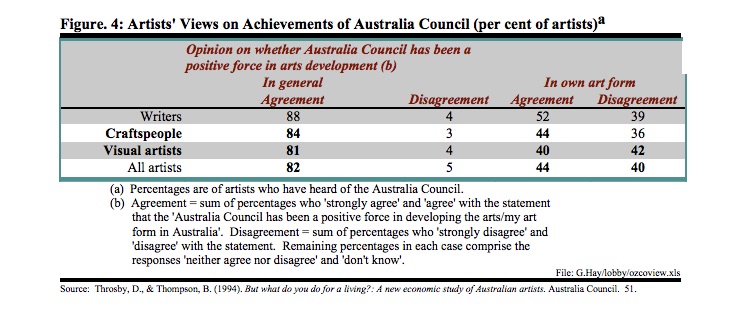
an overwhelmingly favourable view among artists of the achievements of the Australia Council in general terms in fostering and advancing the arts in Australia, with 82 percent of artists agreeing and only 5 percent disagreeing with the proposition. When it comes to artists' own art forms, however, opinions are more divided, with only a slender majority of artists agreeing that the Council has been a positive force in their art form over those holding a contrary view (p. 51).
The more intimate the interaction between artists and the Council, the more distrustful artists become, despite generally positive public comments upon receipt of grants. More politically sensitive data is provided in the appendices of the report, and Figure. 5 is a simplification of Appendix 1 Table 10.3.
The more intimate the interaction between artists and the Council, the more distrustful artists become, despite generally positive public comments upon receipt of grants. More politically sensitive data is provided in the appendices of the report, and Figure. 5 is a simplification of Appendix 1 Table 10.3.
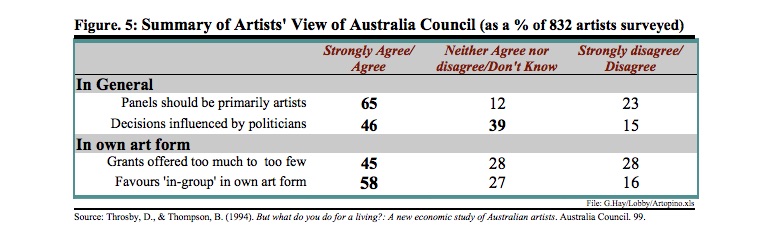
What is apparent from this table is that, while there is a general preference for peer assessment panels, there is also a widely held belief that these panels tend to give too much to too few, favouring an 'in-group' in individual art forms. These findings are consistent with an élite group of people operating within the arts; a conclusion supported by the chair of the Australia Council who criticised a baby boom generation, who received free education and much else that no other generation ever had, has gone on receiving the lion's share of the funds available for their creative development (McPhee, 1995b).
This appears to be because the written, and unwritten, criteria for appointment of professional artists onto the peer assessment panels, and those for making grants to artists, have become too similar. Not surprisingly, the Council moved rapidly this year to dismantle part of the peer-assessment committee system, without widely consulting the industry.
What is perhaps more relevant to this discussion is the large number of professional artists who support Gough's (1995a) criticisms that the Australia Council's decisions are influenced by politicians. The arts media has been instrumental in promoting this positive perspective of the Australia Council and the grants' system, but at the same time have also been reluctant to explore the political repercussions of an élite capturing the system as a result of the similarity between selection criteria for grants and grants committees. Until recently, public debate over the nature of state funding of the arts has been only superficially investigated by the public press, while most art publications remain conspicuously silent.
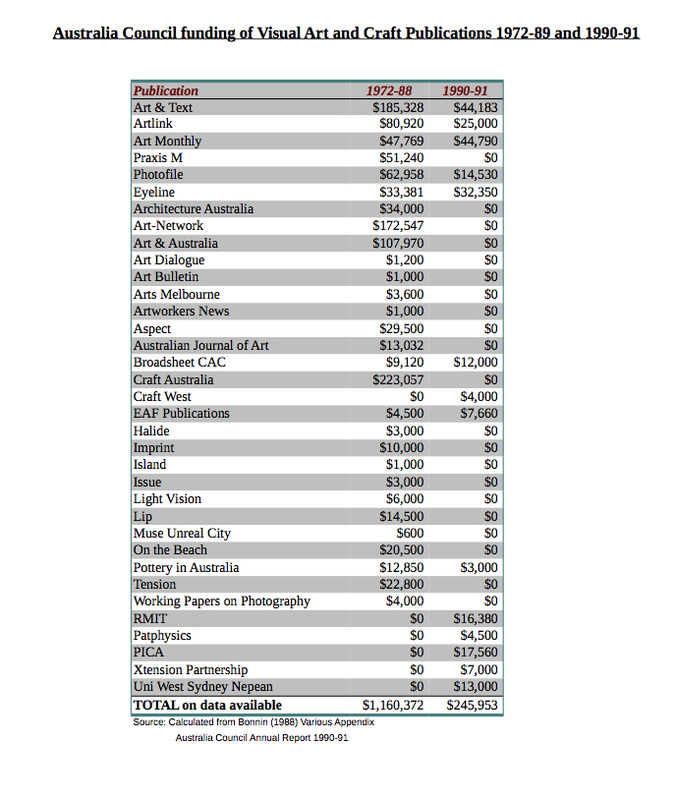
Certainly, most élite art writers, and their editors, have been reluctant to 'bite the hand that feeds' them by publishing, or writing, too critically on the state funding issue (see Appendix.2 for a list of publications receiving funding). There are plenty of examples where writers, and others, politically censor themselves, such as Gray (1995) who avoids providing a contemporary Australian example when discussing politically motivated curatorial and museum intervention (p. 25). In the same journal Throsby, (1995) states that
most arts organisations are well aware that sponsorship may, on occasions, bring with it a danger of some real or imagined influence over the organisation's artistic policy. But that's another story (p. 33).
Throsby is unlikely to publicly tell the "story" of the moderating influence of a grant of $135,000 (63 % of income) on the agenda he sets as chair of NAVA (Annual Report 1995). Neither does he inform us of his conflict of interest in holding this lobby position while being paid by the Council to research and write on the arts (Throsby & Mills, 1989 and Throsby & Thompson, 1994). The average reader is unaware of this because Throsby is missing from the list of writers, and their biographical information, on the inside cover of that issue of Arts Monthly. However, it is stressed that:
[w]hat is at issue is not the honesty of the opinions expressed or the integrity of those who seek the facts but rather the choice of topics and highlighting of issues, the range of opinion permitted expression, the unquestioned premises that guide reporting and commentary, and the general framework imposed for presentation of a certain view of the world (Chomsky, 1989, p. 12).
UNEXPECTED OUTCOMES
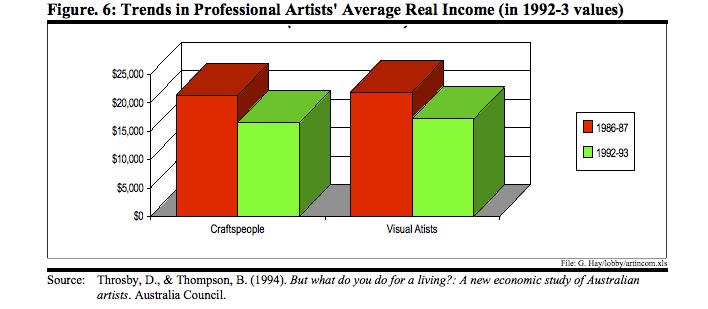
There have been a number of unexpected economic outcomes of the arts-state contract. Professional artists are defined by Throsby & Mills (1989) as artists who have had extensive training and received recent professional recognition via publication, exhibition, engagement or grant (p. 5). Throsby & Thompson (1995) found that, for this group, art income and total artist income, have declined 14 per cent and 13 per cent respectively, over the period 1986-87 to 1992-93 (Table 21). Figure. 6 illustrates the trend in average real incomes for visual artists and craftspeople. "Real" income refers to income after it has been deflated by changes in inflation, giving a better indication of actual purchasing power over time. Throsby & Thompson also found that professional artists believed that insufficient income was the single most critical factor holding back their careers. These low and declining levels of income appear to be occurring despite artists being more highly qualified than the average population, having spent an average of four years to obtain their basic arts qualifications (Throsby & Mills, 1989, p. 8-9). Since these findings are based upon national data, it is suggested that Western Australian professional arts and crafts groups survey their members' art incomes in order to correctly assess the situation here. Probable causes of insufficient and declining average real income, as the single most important issue facing professional artists today.
Yet, despite the arts groups keeping their side of the contract and aligning the arts with state and national cultural objectives, the financial outcomes have been far from outstanding. It is suggested that the arts' inability to maintain its position of relative strength, in its "contractual exchanges" with the state, has resulted in a decline of the real value of state patronage.
This appears to be because the written, and unwritten, criteria for appointment of professional artists onto the peer assessment panels, and those for making grants to artists, have become too similar. Not surprisingly, the Council moved rapidly this year to dismantle part of the peer-assessment committee system, without widely consulting the industry.
What is perhaps more relevant to this discussion is the large number of professional artists who support Gough's (1995a) criticisms that the Australia Council's decisions are influenced by politicians. The arts media has been instrumental in promoting this positive perspective of the Australia Council and the grants' system, but at the same time have also been reluctant to explore the political repercussions of an élite capturing the system as a result of the similarity between selection criteria for grants and grants committees. Until recently, public debate over the nature of state funding of the arts has been only superficially investigated by the public press, while most art publications remain conspicuously silent.
Certainly, most élite art writers, and their editors, have been reluctant to 'bite the hand that feeds' them by publishing, or writing, too critically on the state funding issue (see Appendix.2 for a list of publications receiving funding). There are plenty of examples where writers, and others, politically censor themselves, such as Gray (1995) who avoids providing a contemporary Australian example when discussing politically motivated curatorial and museum intervention (p. 25). In the same journal Throsby, (1995) states that
most arts organisations are well aware that sponsorship may, on occasions, bring with it a danger of some real or imagined influence over the organisation's artistic policy. But that's another story (p. 33).
Throsby is unlikely to publicly tell the "story" of the moderating influence of a grant of $135,000 (63 % of income) on the agenda he sets as chair of NAVA (Annual Report 1995). Neither does he inform us of his conflict of interest in holding this lobby position while being paid by the Council to research and write on the arts (Throsby & Mills, 1989 and Throsby & Thompson, 1994). The average reader is unaware of this because Throsby is missing from the list of writers, and their biographical information, on the inside cover of that issue of Arts Monthly. However, it is stressed that:
[w]hat is at issue is not the honesty of the opinions expressed or the integrity of those who seek the facts but rather the choice of topics and highlighting of issues, the range of opinion permitted expression, the unquestioned premises that guide reporting and commentary, and the general framework imposed for presentation of a certain view of the world (Chomsky, 1989, p. 12).
UNEXPECTED OUTCOMES
There have been a number of unexpected economic outcomes of the arts-state contract. Professional artists are defined by Throsby & Mills (1989) as artists who have had extensive training and received recent professional recognition via publication, exhibition, engagement or grant (p. 5). Throsby & Thompson (1995) found that, for this group, art income and total artist income, have declined 14 per cent and 13 per cent respectively, over the period 1986-87 to 1992-93 (Table 21). Figure. 6 illustrates the trend in average real incomes for visual artists and craftspeople. "Real" income refers to income after it has been deflated by changes in inflation, giving a better indication of actual purchasing power over time. Throsby & Thompson also found that professional artists believed that insufficient income was the single most critical factor holding back their careers. These low and declining levels of income appear to be occurring despite artists being more highly qualified than the average population, having spent an average of four years to obtain their basic arts qualifications (Throsby & Mills, 1989, p. 8-9). Since these findings are based upon national data, it is suggested that Western Australian professional arts and crafts groups survey their members' art incomes in order to correctly assess the situation here. Probable causes of insufficient and declining average real income, as the single most important issue facing professional artists today.
Yet, despite the arts groups keeping their side of the contract and aligning the arts with state and national cultural objectives, the financial outcomes have been far from outstanding. It is suggested that the arts' inability to maintain its position of relative strength, in its "contractual exchanges" with the state, has resulted in a decline of the real value of state patronage.
The general perception that federal funding has increased over the last two decades is, in fact, incorrect. While the state has increased its support of the arts from the 1960s, the real financial value of this has declined because no formula for funding was ever set in the Australia Council Act. As illustrated in Figure. 7, Federal Government funding of the Australia Council may have increased from $22m in 1974/5 to $59.2m in 1994/5, but, after inflation, its real value has halved. This trend is anticipated to continue in the near future.
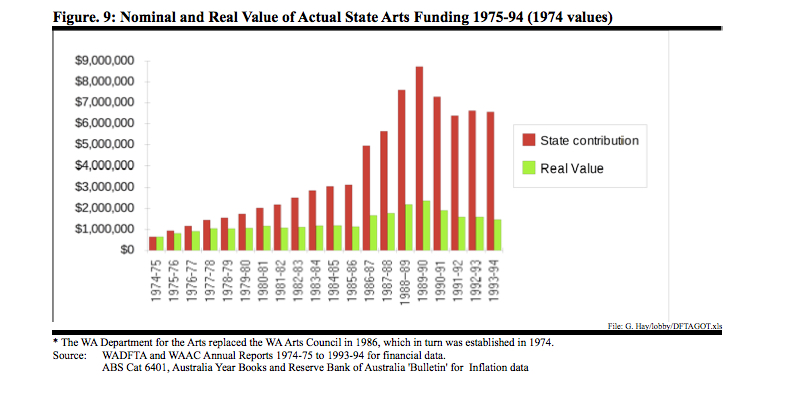
In Western Australia there has been a similar masking of the real level of government arts funding because of the contribution made by the Lotteries Commission to the WADFTA budget. Figure. 8 illustrates how the Department has been receiving an increasing proportion of its total income from the Lotteries Commission. If the substantial Lotteries Commission contribution is removed, and the balance adjusted for inflation, a much more modest increase in state funding appears to have occurred over the last two decades (Figure. 9). In the short term, since 1989-90, there has been a nominal drop of $2 million in state funding, disguised by a $2.5 million increase in funding from the Lotteries Commission.
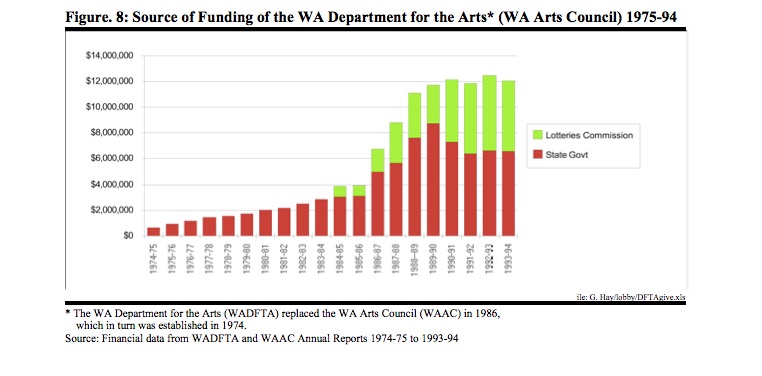
The outlook for State Government funding of the arts is likely to follow the national trend downwards. According to the WADFTA Senior Program Manager, speaking at the 1994 Annual General Meeting of the peak WA art lobby group Arts Voice, the WA Arts Minister, Peter Foss, "expected the level of State Government funding [of the arts] to decrease rather than increase" (Minutes).
In summarising, this section has clearly documented a substantial erosion of the real value of state patronage of the arts over the last 20 years, particularly at national levels. Corporatism theory suggests that the arts appear to be unable to maintain a permanent lobby on behalf of the Australia Council and the WADFTA to ensure that their funding, relative to all other competing state departments, is maintained. Certainly, it was not until just before the last state election, and the real possibility of a collapse in art funding arising from a change in government, that the peak visual and performing arts group, Arts Voice, was formed. Fortunately, it was able to review and influence the Liberal's arts policy before the election. Future arts funding will depend upon the ability of this group to influence Cabinet and Treasury.
FUTURE DIRECTIONS
Attempts by the Australia Council and WADFTA to increase professional artists' average real incomes, by promoting private demand for the arts, are unlikely to be successful because there are no real limits on the supply of professional artists. Consequently, increased demand will not cause an increase in the average income of professional artists.
Gough's assumption that the arts cannot "flourish" in Australia because there is an insufficient number of people enjoying the arts in some amateur capacity (p. 159) ignores the fact that just under 49 per cent of all adults attended art exhibitions yearly (Hides, 1995a, p. 14-15).
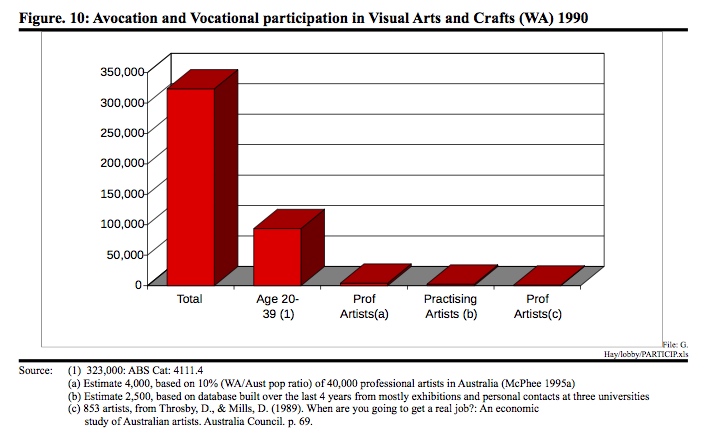
What this survey indicates is that there is already a very high level of demand for art within the community. In addition, over 38 per cent of adults participate in art/craft activity (ABS, 1991, p. 5) indicating a huge group who can substantially influence professional artists' incomes by entering and exiting the art market with their own artwork. Figure. 10 indicates the huge overhang of recreational artists/craftspeople above professional artists. The range of estimates of the number of professional artists indicates the difficulty in quantifying the size of this group.
FUTURE DIRECTIONS
Attempts by the Australia Council and WADFTA to increase professional artists' average real incomes, by promoting private demand for the arts, are unlikely to be successful because there are no real limits on the supply of professional artists. Consequently, increased demand will not cause an increase in the average income of professional artists.
Gough's assumption that the arts cannot "flourish" in Australia because there is an insufficient number of people enjoying the arts in some amateur capacity (p. 159) ignores the fact that just under 49 per cent of all adults attended art exhibitions yearly (Hides, 1995a, p. 14-15).
What this survey indicates is that there is already a very high level of demand for art within the community. In addition, over 38 per cent of adults participate in art/craft activity (ABS, 1991, p. 5) indicating a huge group who can substantially influence professional artists' incomes by entering and exiting the art market with their own artwork. Figure. 10 indicates the huge overhang of recreational artists/craftspeople above professional artists. The range of estimates of the number of professional artists indicates the difficulty in quantifying the size of this group.
Gough (1995a) not only contradicts his whole critique of state funding by calling for increased funding and subsidising of the "cost of musical instruments, art materials, and lessons in music and painting" (p. 167), but ignores the likely impact this will have on the total quantity (increase) and prices (decline) of all artwork (recreational and professional), thus depressing average incomes. This inability to comprehend the extent of community involvement in the arts, and differentiate between professional and recreational supply and demand, also exists within senior levels of the Australia Council. McPhee's (1995a) response to discovering that there are 40,000 professional practising artists (from the same report that showed the decline in average real income) was "a steadily growing conviction that we should try to make more of them - for the good of us all" (p. 5)!
What Gough and McPhee appear to believe is that since 'art is good, more art is better', regardless of the likely impact on artistic standards and income levels. Promoting the emergence of professional artists should be distinctly different from promoting a wider recreational participation in the arts.
Professional artists' groups might consider lobbying the state to develop distinct policies, between those which generally foster the arts and those which foster an improvement in professional artists' real income.
On the other side of the economic coin to demand is supply management. Like professional artists, doctors, lawyers, accountants and other professionals believe that what they do is beneficial to the community. While these professions may encourage people to become more educated about health, legal and taxation matters, they never increase the size of their profession to the detriment of professional standards or income. Thus, vocational training is kept distinctly separate from community education programs influencing attitudes and habits.
In examining Australia's engineering profession, Edelstein (1987) emphasised the importance of in and out flows, rather than the size of the profession. Net flow of entrants into an occupation has a major impact on professional standards and incomes. Kessel (1975), Nieuwenhuysen & Williams-Wynn (1982) have examined how the Australian Medical Association has prevented an erosion of professional standards and prices by influencing medical school intake levels and the number of accredited training hospitals. Within accounting and law, professional practitioners are legally required to belong to an accredited body, or to undergo annual training. It is these state backed institutional restrictions on entry and re-entry to the profession, that have protected practitioners from an erosion in standards, income levels and status. Currently, no such links exist between the state, universities and arts groups, although favourable conditions exist for these to be established and formalised through institutionalisation.
There has been no overall, coherent policy guiding university art education intake levels in Western Australia for the last decade. In Western Australia there have been reviews of post-secondary art education by the Western Australian Post Secondary Education Commission (WAPSEC) in 1979 and 1985. Both reviews promoted the continued development of post-secondary art education but were mindful of the impact of student numbers on standards and incomes. For example, the first review recommended "that the number of undergraduate places for career oriented students be gradually increased commensurate with anticipated growth in community need" (emphasis added) (p. 59). The report's recommendations suggested an implicit appreciation of the small size of the local market for artists and their work, as well as the negative impact of an excessive number of graduates on incomes.
The last review of the university art schools, in 1985, was a response to a relatively better position for performing arts education in Western Australia (p. xi, 6). The WA Academy of Performing Arts had been recently established, under state legislation, as a dedicated local centre for vocational training excellence, with a high level of recurrent state and federal funding. Consequently, the report recommended a new centre for excellence in visual arts education, modelled on the Academy. Based at Mount Lawley, it would incorporate WAIT's existing Bachelors degree . . . approved associate diploma, graduate diploma and Masters degree programs, with priority in making appointments to be given to WAIT and WA college staff . . . [and] the transfer of resources associated with the existing WAIT programs (p. xiv).
Since then, the WA School of Art has been established within the Academy of Performing Arts, now a part of Edith Cowan University, and the University of Western Australia has established a Bachelor of Fine Arts course, both offering vocational visual arts training.
The unforseen negative consequence of three rather than two art schools has been an almost doubling of the total number of visual arts enrolments (from about 240 to over 510) over the ten year period. It is anticipated that, with the three art schools competing for the same pool of students, there will be an erosion in average student standards at entry and exit levels. Furthermore, demand for entry to art school does not indicate community demand for artists, but rather the numbers going through secondary schools and the huge stock of recreational and part-time artists. Demand for entry may, in fact, indicate the attractiveness of Austudy as an income support, relative to operating in a collapsed market. The latter simply pushes professional artists back into a part-time practice.
Professional artists, through their professional groups, would be wise to seek a joint group-state review and resolution of this situation, considering its impact on their incomes and standards. It is acknowledged that this would create a conflict of interest for some academics who are involved closely with the professional groups, and are insulated from a depressed market by tenure or contract employment.
This paper started with the intention to use corporatism theory to organise an experiential knowledge of the arts and to test the validity of Gough's criticisms of the art-state relationship. Corporatism emphasised the political and policy role of special interest groups, which Gough has omitted completely in his critique of state funding of the arts. The focus was to examine corporatism's emphasis upon the reciprocal nature of negotiated exchanges between the groups' élite and the state, within an environment of shared ideologies, and the state's sanctioning of the élite's monopoly of representation.
Gough's paper focuses upon the apparent shared ideologies, with no appreciation of their importance in the Australia Council's evolution and continued negotiated exchanges between the state and art groups. His explanation of the avant-gardé as a source of the dominant ideology within the arts is enhanced with an addition of universities as agents perpetuating and spreading these values. Within this shared ideological environment, special interest groups lobby on behalf of their members, themselves and the Australia Council for the transfer of responsibilities and funds to themselves. However, it is their specific ability to share in the development and implementation of policy that makes them unique. Historically, these "negotiated exchanges" have been formalised into legislation such as that underpinning the Australia Council, which was designed to overcome the 'cultural cringe' and prevent talent moving overseas.
A major influence on artists' assessment of the Australia Council was a 'vow of silence' by art writers and publishers receiving grants, resulting in professional artists perceiving the Council favourably, except concerning its structural biases towards favouritism and political interference. Given the existence of, and support for, the grants' system it was unexpected to discover that the average real income of professional artists had declined. This prompted an examination of the real trend of state funding of the arts, which was discovered to be declining, especially at the federal level. This suggests that while the arts have formalised relationships with the state through the Australia Council and the WADFTA, the many special interest groups appear collectively weak in directly arguing with the state, particularly at the national level. The imbalance in relations between arts groups and the state should not be seen as permanent, but rather an indication of a lack of appreciation of the problem and its solutions by administrators, writers and artists.
Current policy moves by the Australia Council, and the WADFTA, to increase art demand does not differentiate between promoting a general participation/appreciation of the arts, and improving the aesthetic and economic position of professional artists. Other professional bodies have been very careful to prevent community awareness campaigns from affecting the quality and price of professional goods or services provided. Restricted entry to the profession has also been important to at least three occupations in maintaining quality and incomes. Recent evidence from Western Australia indicates a lack of awareness of these simple principles, resulting in an excessive jump in university art student numbers.
The use of theories of corporatism increases awareness of the role that professional associations play in shaping government policy and, also, in affecting artists' income. Consequently, three recommendations are made. Firstly, that local professional art/craft associations annually survey their joint membership to more effectively identify and lobby the economic concerns of their members. Secondly, that these groups seek the Australia Council and WADFTA to increasingly differentiate between recreational and professional artists/craftspeople in policy development. Lastly, that these associations call for a state review to establish a more co-ordinated approach to university art education in Western Australia.
BIBLIOGRAPHY
Abbs, P. (1989). A is for aesthetic: Essays on creative and aesthetic education. Sussex: The Falmer Press.
Albertoni, E. A. (1985). Mosca and the Theory of Elitism (trans. P.Goodrick). Oxford: Basil Blackwell.
ABS (Australian Bureau of Statistics). (1991). Arts and crafts: Purchasing and participation: Western Australia October 1990. Perth: Author of Report.
Althusser, L. (1976). Essays in Self-Criticism (Trans. G. Lock). London: NBL.
Anderson, P. (1992). Incidental benefits? Arts industry rhetoric & policy objectives. Artlink, 12, (3), 30-31.
Arnheim, R. (1989). Thoughts on art education. California: The Getty Centre for Education in the Arts.
Australia Council. (1991). Annual Report 1990-1991. Sydney: Author of the report.
----- (1994). Annual Report 1993-1994. Sydney: Author of the report.
Bennett, T. & Frow, F. (1991). Art galleries: Who goes? A study of visitors to three Australian art galleries, with international comparisons. New South Wales: Australia Council.
Bennett, R. (1986). The making of a plot. In P. O'Brien (Ed.), The Burke Ambush. Perth: Apollo Press. 40-49.
Bennett, R. & Poprzeczny, J. (1986). Jobs for the boys: Burke's pillars of power. In P. O'Brien (Ed.), The Burke Ambush. Perth: Apollo Press. 138-167.
Black, S. (1992). Meeting Challenges. Pottery in Australia. 31, (4). 20-21 & 66.
Badham, H. (1949). A study of Australian Art. Sydney: Currawong Publishing.
Bachelard, G. (1994). The poetics of space (Trans. M. Jolas). Boston: Beacon Press.
Barker, B. (1993). Michael Foucault: Subversions of the subject. Sydney: Allen & Unwin.
Barnes, B. (1988). The nature of power. England: Polity Press.
Bonnin, M. (1988). Publications review. New South Wales: Australia Council: Visual Arts and Craft Board.
Bowker, G., & Sankey, H. (1994). Truth and reality in social constructivism. Arena, (2), 233-252.
Buzan, T., & Buzan, B. (1993). The mind map book. London: BBC Books.
Burn, I. (1991). Dialogues. Sydney: Allen & Unwin.
Cawelti, S., Rappaport, A., & Wood, B. (1992). Modeling Artistic Creativity: An empirical study. The Journal of Creative Behaviour, 26, (2), 83-94.
Chomsky, N. (1989). Necessary illusions. Boston: Southend Press.
Considine, M. (1995). Public Policy: A critical approach. Melbourne: MacMillan Education.
Cork, R. (1978). Editorial. Studio International: Journal of modern art, 194, (988), 7.
Cox, A., & O'Sullivan, N. (Ed.). (1988). The corporate state: Corporatism and the state tradition in Western Europe. England: Edward Elgar.
Gray, C. (1995). Curatorship: Critical or political intervention? Arts Monthly, (84), 25-26.
Grant, W. (Ed.). (1985). The Political Economy of corporatism. London: MacMillan.
Curran, J. (Ed.). (1978). The British Press: A manifesto. London: MacMillan.
DASETT (Department of the Arts, Sport, the Environment, Tourism and Territories). (1991). Annual Report 1990-91. Canberra: Australian Government Publishing Service.
DCA (Department of Communications and the Arts). (1995). Creative Nation: Commonwealth cultural policy. Canberra: Australian Government Publishing Services.
----- Annual Report 1993-94. Canberra: Australian Government Publishing Services.
DEET (Department of Education, Employment and Training). (1994). Submission in Submissions to Senate Standing Committee on Environment, Recreation and the Arts: Arts Education Inquiry: Canberra: Australian Government Publishing Services. 7.
Devine, F. (1995). Misplaced blots on landscape of arts bureaucracy. The Australian, September 4, 11.
Edelstein, M. (1987). Professional engineers in the Australian economy: Some quantitative dimensions 1866-1980: Working Papers in economic history. Canberra: Australian National University.
EDWA (Education Department of Western Australia). (1994). In Submissions to Senate Standing Committee on Environment, Recreation and the Arts: Arts education Inquiry: Canberra: Australian Government Publishing Services. 6.
Frome, K. (1993). A forced perspective: Aerial photography and fascist propaganda. Aperture, (132), Summer, 76-77.
Fuller, P. (1978). The Tate, the state and english tradition. Studio International: Journal of modern art, 194, (988), 4-18.
Gaarder, J. (1995). Sophie's World: A novel about the history of philosophy (Trans P. Mfller). London: Phoenix House.
Gough, A. (1995a). The Faustian Bargain: Government Sponsorship of the Arts. Agenda, 2, (2), 159-167.
----- (1995b). Arts for whose sake? The Weekend Australian Magazine. April 29-30, 27.
Grant, W. (Ed.). (1985). The political economy of corporatism. London: MacMillan.
Hay, G. (1995a). In the shadow of text. Unpublished honours paper.
----- (1995b). Proposed changes. Pyre. Perth: Clay and Glass Association of Western Australia. (November), (forthcoming).
Hides, D. (1995a). How important are the arts? Public attitudes to the arts. Perth: Western Australian Department for the Arts.
----- (1995b). Performing arts patrons: A graphical report of 1994 and 1995 generic patrons survey findings. Perth: Western Australian Department for the Arts.
Hirst, P. (1993). Foucault and Architecture. AA Files, (26), Autumn, 2, 53-60.
Hunter, I. (1994). Bureaucrat, critic, citizen: On some styles of ethical life. Arena, (2), 77-101.
Indiana, G. (1986). Reviews: Rooted rhetoric, Castel Dell' Oro, Naples. Flash Art, (130), 83-84.
Ioannu, N. (Spring 1992). Interventions: The elusiveness of craft theory and other musings: A conference report. Craftwest, 18-20.
Jacobson, H. (1993). Listen! is that art I hear? The Independent Monthly, (August), 44-45.
Jacobson, M. (1991). Art & business: New strategies for corporate collecting. London: Thames and Hudson.
Jagtenberg, T., & D'Alton. P.C. (1992). Four dimensional social space: Class, gender, ethnicity and nature. NSW: Harper Educational.
Kessel, R. A. (1975). Price discrimination in medicine. In E. Mansfield (Ed.), Microeconomics: Selected readings (2nd Ed). New York: WW Norton & Co. 272-293.
La Biennale di Venezia. (1995). Identity and alterity: figures of the body 1895/1995. Venice: Marsilio.
Le Van, B. (1989). Material, signature and memory. Ceramics Monthly, May, 39-43.
McPhee, H. (1995a). Creative Tension. Speech to the Sydney Institute: 29 August. Unpublished.
----- (1995b). Interviewed. Lateline. Australia: ABC TV(National). (September 21, 10.30 pm).
McCarthy, G. (1992). The Recession and the arts. Artlink 12, (3), 16-18.
Nielsen, K. (1994). Reconceptualizing civil society for now: Some somewhat Gramscian Turnings. Arena, (2), 159-174.
Nieuwenhuysen, J., & Williams-Wynn, M. (1982). Professions in the marketplace. Australia: Melbourne University Press.
O'Brien, P. (Ed.). (1986). The Burke Ambush. Perth: Apollo Press.
Schmitter, P. C., & Schmitter, G. (Eds.). (1979). Trends toward corporatist intermediation. London: Sage.
Scholten, I. (Ed.). (1987). Political stability and neo-corporatism: Corporatist integration and societal cleavages in western Europe. London: Sage.
Slattery, L. (1995). The art of being Robert Hughes. The Australian magazine, (August 12-13), 16-23.
----- (1995b). Turmoil in the creative nation. The Australian magazine, (September 2-3), 27.
Sommerville, R. (1993 June). Theory Galahs. Broadsheet, 22, (2), 7-8.
Spring, J. (1991). Culture on Holiday: A survey of Australian domestic tourists' cultural participation December 1990 - April 1991. New South Wales: Australia Council.
Standing, L. (1973). Learning 10,000 pictures. Quarterly Journal of Experimental Psychology, (25), 207-222.
Sykes, J. B. (Ed.). (1984). The concise Oxford dictionary of current English (7th ed.). Oxford: Oxford University Press.
Tcherkezoff, S. (1983). Dual classification reconsidered: Nyamwezi sacred kingship and other examples. (Trans. M. Thom). Paris & Cambridge: Editions De La Maison Des Sciences De L'Homme and Cambridge University Press.
The Getty Centre for Education in the Arts. (1989). Inheriting the theory: New voices and multiple perspectives on DBAE: Seminar proceedings, May 4-7, 1987, Austin, Texas. California: The J. Paul Getty Trust.
The Getty Centre for Education in the Arts (1993). Discipline-based art education and cultural diversity: Seminar proceedings, August 6-9, 1992, Austin, Texas. California: The J. Paul Getty Trust.
Thompson, B. (1992). Public gesture, private sneer-public art and politics in the Australian context. Art & Text, 42, 26-29.
Throsby, D., & Mills, D. (1989). When are you going to get a real job? An economic study of Australian artists. Sydney: Australia Council.
Throsby, D., & Thompson, B. (1994). But what do you do for a living? A new economic study of Australian artists. Sydney: Australia Council.
Throsby, D. (1995). Private gain, public loss. Arts Monthly, (84), 33.
Timms, P. (1995). Art: A substitute for political action? Museum National, 4, (1), 4-6.
Vandenheuvel, A., & Wooden, M. (1995). Self-employed contractors in Australia: How many and who are they? The Journal of Industrial Relations, 37, (3), 263-280.
WAPSEC (Western Australian Post Secondary Education Commission). (1979). Art, Craft and Design education: A study of the opportunities and requirements in the post secondary sector in Western Australia. Perth: WAPSEC.
WAPSEC (Western Australian Post Secondary Education Commission). (1985). The visual arts: A review of post secondary visual arts education in Western Australia. Perth: WAPSEC.
Wexler, P. (1994). Educational corporatism and its counterposes. Arena, (2),175-194.
Walker, D. (1992 August). Investigating the shifting scenario. Craftwest: National. 23-29.
Watson, G. (1978). The Discipline of English: A guide to critical theory and practice, United Kingdom: MacMillan Press.
Watts, R. (1994). Government and modernity: An essay in thinking governmentality. Arena, (2), 103-157.
WADFTA (Western Australian Department for the Arts). Annual Report (various). Perth: Western Australian Government.
Wong, D. (1979). Power: Its forms, bases and uses. Oxford: Basil Blackwell.
Appendix. 2:
What Gough and McPhee appear to believe is that since 'art is good, more art is better', regardless of the likely impact on artistic standards and income levels. Promoting the emergence of professional artists should be distinctly different from promoting a wider recreational participation in the arts.
Professional artists' groups might consider lobbying the state to develop distinct policies, between those which generally foster the arts and those which foster an improvement in professional artists' real income.
On the other side of the economic coin to demand is supply management. Like professional artists, doctors, lawyers, accountants and other professionals believe that what they do is beneficial to the community. While these professions may encourage people to become more educated about health, legal and taxation matters, they never increase the size of their profession to the detriment of professional standards or income. Thus, vocational training is kept distinctly separate from community education programs influencing attitudes and habits.
In examining Australia's engineering profession, Edelstein (1987) emphasised the importance of in and out flows, rather than the size of the profession. Net flow of entrants into an occupation has a major impact on professional standards and incomes. Kessel (1975), Nieuwenhuysen & Williams-Wynn (1982) have examined how the Australian Medical Association has prevented an erosion of professional standards and prices by influencing medical school intake levels and the number of accredited training hospitals. Within accounting and law, professional practitioners are legally required to belong to an accredited body, or to undergo annual training. It is these state backed institutional restrictions on entry and re-entry to the profession, that have protected practitioners from an erosion in standards, income levels and status. Currently, no such links exist between the state, universities and arts groups, although favourable conditions exist for these to be established and formalised through institutionalisation.
There has been no overall, coherent policy guiding university art education intake levels in Western Australia for the last decade. In Western Australia there have been reviews of post-secondary art education by the Western Australian Post Secondary Education Commission (WAPSEC) in 1979 and 1985. Both reviews promoted the continued development of post-secondary art education but were mindful of the impact of student numbers on standards and incomes. For example, the first review recommended "that the number of undergraduate places for career oriented students be gradually increased commensurate with anticipated growth in community need" (emphasis added) (p. 59). The report's recommendations suggested an implicit appreciation of the small size of the local market for artists and their work, as well as the negative impact of an excessive number of graduates on incomes.
The last review of the university art schools, in 1985, was a response to a relatively better position for performing arts education in Western Australia (p. xi, 6). The WA Academy of Performing Arts had been recently established, under state legislation, as a dedicated local centre for vocational training excellence, with a high level of recurrent state and federal funding. Consequently, the report recommended a new centre for excellence in visual arts education, modelled on the Academy. Based at Mount Lawley, it would incorporate WAIT's existing Bachelors degree . . . approved associate diploma, graduate diploma and Masters degree programs, with priority in making appointments to be given to WAIT and WA college staff . . . [and] the transfer of resources associated with the existing WAIT programs (p. xiv).
Since then, the WA School of Art has been established within the Academy of Performing Arts, now a part of Edith Cowan University, and the University of Western Australia has established a Bachelor of Fine Arts course, both offering vocational visual arts training.
The unforseen negative consequence of three rather than two art schools has been an almost doubling of the total number of visual arts enrolments (from about 240 to over 510) over the ten year period. It is anticipated that, with the three art schools competing for the same pool of students, there will be an erosion in average student standards at entry and exit levels. Furthermore, demand for entry to art school does not indicate community demand for artists, but rather the numbers going through secondary schools and the huge stock of recreational and part-time artists. Demand for entry may, in fact, indicate the attractiveness of Austudy as an income support, relative to operating in a collapsed market. The latter simply pushes professional artists back into a part-time practice.
Professional artists, through their professional groups, would be wise to seek a joint group-state review and resolution of this situation, considering its impact on their incomes and standards. It is acknowledged that this would create a conflict of interest for some academics who are involved closely with the professional groups, and are insulated from a depressed market by tenure or contract employment.
This paper started with the intention to use corporatism theory to organise an experiential knowledge of the arts and to test the validity of Gough's criticisms of the art-state relationship. Corporatism emphasised the political and policy role of special interest groups, which Gough has omitted completely in his critique of state funding of the arts. The focus was to examine corporatism's emphasis upon the reciprocal nature of negotiated exchanges between the groups' élite and the state, within an environment of shared ideologies, and the state's sanctioning of the élite's monopoly of representation.
Gough's paper focuses upon the apparent shared ideologies, with no appreciation of their importance in the Australia Council's evolution and continued negotiated exchanges between the state and art groups. His explanation of the avant-gardé as a source of the dominant ideology within the arts is enhanced with an addition of universities as agents perpetuating and spreading these values. Within this shared ideological environment, special interest groups lobby on behalf of their members, themselves and the Australia Council for the transfer of responsibilities and funds to themselves. However, it is their specific ability to share in the development and implementation of policy that makes them unique. Historically, these "negotiated exchanges" have been formalised into legislation such as that underpinning the Australia Council, which was designed to overcome the 'cultural cringe' and prevent talent moving overseas.
A major influence on artists' assessment of the Australia Council was a 'vow of silence' by art writers and publishers receiving grants, resulting in professional artists perceiving the Council favourably, except concerning its structural biases towards favouritism and political interference. Given the existence of, and support for, the grants' system it was unexpected to discover that the average real income of professional artists had declined. This prompted an examination of the real trend of state funding of the arts, which was discovered to be declining, especially at the federal level. This suggests that while the arts have formalised relationships with the state through the Australia Council and the WADFTA, the many special interest groups appear collectively weak in directly arguing with the state, particularly at the national level. The imbalance in relations between arts groups and the state should not be seen as permanent, but rather an indication of a lack of appreciation of the problem and its solutions by administrators, writers and artists.
Current policy moves by the Australia Council, and the WADFTA, to increase art demand does not differentiate between promoting a general participation/appreciation of the arts, and improving the aesthetic and economic position of professional artists. Other professional bodies have been very careful to prevent community awareness campaigns from affecting the quality and price of professional goods or services provided. Restricted entry to the profession has also been important to at least three occupations in maintaining quality and incomes. Recent evidence from Western Australia indicates a lack of awareness of these simple principles, resulting in an excessive jump in university art student numbers.
The use of theories of corporatism increases awareness of the role that professional associations play in shaping government policy and, also, in affecting artists' income. Consequently, three recommendations are made. Firstly, that local professional art/craft associations annually survey their joint membership to more effectively identify and lobby the economic concerns of their members. Secondly, that these groups seek the Australia Council and WADFTA to increasingly differentiate between recreational and professional artists/craftspeople in policy development. Lastly, that these associations call for a state review to establish a more co-ordinated approach to university art education in Western Australia.
BIBLIOGRAPHY
Abbs, P. (1989). A is for aesthetic: Essays on creative and aesthetic education. Sussex: The Falmer Press.
Albertoni, E. A. (1985). Mosca and the Theory of Elitism (trans. P.Goodrick). Oxford: Basil Blackwell.
ABS (Australian Bureau of Statistics). (1991). Arts and crafts: Purchasing and participation: Western Australia October 1990. Perth: Author of Report.
Althusser, L. (1976). Essays in Self-Criticism (Trans. G. Lock). London: NBL.
Anderson, P. (1992). Incidental benefits? Arts industry rhetoric & policy objectives. Artlink, 12, (3), 30-31.
Arnheim, R. (1989). Thoughts on art education. California: The Getty Centre for Education in the Arts.
Australia Council. (1991). Annual Report 1990-1991. Sydney: Author of the report.
----- (1994). Annual Report 1993-1994. Sydney: Author of the report.
Bennett, T. & Frow, F. (1991). Art galleries: Who goes? A study of visitors to three Australian art galleries, with international comparisons. New South Wales: Australia Council.
Bennett, R. (1986). The making of a plot. In P. O'Brien (Ed.), The Burke Ambush. Perth: Apollo Press. 40-49.
Bennett, R. & Poprzeczny, J. (1986). Jobs for the boys: Burke's pillars of power. In P. O'Brien (Ed.), The Burke Ambush. Perth: Apollo Press. 138-167.
Black, S. (1992). Meeting Challenges. Pottery in Australia. 31, (4). 20-21 & 66.
Badham, H. (1949). A study of Australian Art. Sydney: Currawong Publishing.
Bachelard, G. (1994). The poetics of space (Trans. M. Jolas). Boston: Beacon Press.
Barker, B. (1993). Michael Foucault: Subversions of the subject. Sydney: Allen & Unwin.
Barnes, B. (1988). The nature of power. England: Polity Press.
Bonnin, M. (1988). Publications review. New South Wales: Australia Council: Visual Arts and Craft Board.
Bowker, G., & Sankey, H. (1994). Truth and reality in social constructivism. Arena, (2), 233-252.
Buzan, T., & Buzan, B. (1993). The mind map book. London: BBC Books.
Burn, I. (1991). Dialogues. Sydney: Allen & Unwin.
Cawelti, S., Rappaport, A., & Wood, B. (1992). Modeling Artistic Creativity: An empirical study. The Journal of Creative Behaviour, 26, (2), 83-94.
Chomsky, N. (1989). Necessary illusions. Boston: Southend Press.
Considine, M. (1995). Public Policy: A critical approach. Melbourne: MacMillan Education.
Cork, R. (1978). Editorial. Studio International: Journal of modern art, 194, (988), 7.
Cox, A., & O'Sullivan, N. (Ed.). (1988). The corporate state: Corporatism and the state tradition in Western Europe. England: Edward Elgar.
Gray, C. (1995). Curatorship: Critical or political intervention? Arts Monthly, (84), 25-26.
Grant, W. (Ed.). (1985). The Political Economy of corporatism. London: MacMillan.
Curran, J. (Ed.). (1978). The British Press: A manifesto. London: MacMillan.
DASETT (Department of the Arts, Sport, the Environment, Tourism and Territories). (1991). Annual Report 1990-91. Canberra: Australian Government Publishing Service.
DCA (Department of Communications and the Arts). (1995). Creative Nation: Commonwealth cultural policy. Canberra: Australian Government Publishing Services.
----- Annual Report 1993-94. Canberra: Australian Government Publishing Services.
DEET (Department of Education, Employment and Training). (1994). Submission in Submissions to Senate Standing Committee on Environment, Recreation and the Arts: Arts Education Inquiry: Canberra: Australian Government Publishing Services. 7.
Devine, F. (1995). Misplaced blots on landscape of arts bureaucracy. The Australian, September 4, 11.
Edelstein, M. (1987). Professional engineers in the Australian economy: Some quantitative dimensions 1866-1980: Working Papers in economic history. Canberra: Australian National University.
EDWA (Education Department of Western Australia). (1994). In Submissions to Senate Standing Committee on Environment, Recreation and the Arts: Arts education Inquiry: Canberra: Australian Government Publishing Services. 6.
Frome, K. (1993). A forced perspective: Aerial photography and fascist propaganda. Aperture, (132), Summer, 76-77.
Fuller, P. (1978). The Tate, the state and english tradition. Studio International: Journal of modern art, 194, (988), 4-18.
Gaarder, J. (1995). Sophie's World: A novel about the history of philosophy (Trans P. Mfller). London: Phoenix House.
Gough, A. (1995a). The Faustian Bargain: Government Sponsorship of the Arts. Agenda, 2, (2), 159-167.
----- (1995b). Arts for whose sake? The Weekend Australian Magazine. April 29-30, 27.
Grant, W. (Ed.). (1985). The political economy of corporatism. London: MacMillan.
Hay, G. (1995a). In the shadow of text. Unpublished honours paper.
----- (1995b). Proposed changes. Pyre. Perth: Clay and Glass Association of Western Australia. (November), (forthcoming).
Hides, D. (1995a). How important are the arts? Public attitudes to the arts. Perth: Western Australian Department for the Arts.
----- (1995b). Performing arts patrons: A graphical report of 1994 and 1995 generic patrons survey findings. Perth: Western Australian Department for the Arts.
Hirst, P. (1993). Foucault and Architecture. AA Files, (26), Autumn, 2, 53-60.
Hunter, I. (1994). Bureaucrat, critic, citizen: On some styles of ethical life. Arena, (2), 77-101.
Indiana, G. (1986). Reviews: Rooted rhetoric, Castel Dell' Oro, Naples. Flash Art, (130), 83-84.
Ioannu, N. (Spring 1992). Interventions: The elusiveness of craft theory and other musings: A conference report. Craftwest, 18-20.
Jacobson, H. (1993). Listen! is that art I hear? The Independent Monthly, (August), 44-45.
Jacobson, M. (1991). Art & business: New strategies for corporate collecting. London: Thames and Hudson.
Jagtenberg, T., & D'Alton. P.C. (1992). Four dimensional social space: Class, gender, ethnicity and nature. NSW: Harper Educational.
Kessel, R. A. (1975). Price discrimination in medicine. In E. Mansfield (Ed.), Microeconomics: Selected readings (2nd Ed). New York: WW Norton & Co. 272-293.
La Biennale di Venezia. (1995). Identity and alterity: figures of the body 1895/1995. Venice: Marsilio.
Le Van, B. (1989). Material, signature and memory. Ceramics Monthly, May, 39-43.
McPhee, H. (1995a). Creative Tension. Speech to the Sydney Institute: 29 August. Unpublished.
----- (1995b). Interviewed. Lateline. Australia: ABC TV(National). (September 21, 10.30 pm).
McCarthy, G. (1992). The Recession and the arts. Artlink 12, (3), 16-18.
Nielsen, K. (1994). Reconceptualizing civil society for now: Some somewhat Gramscian Turnings. Arena, (2), 159-174.
Nieuwenhuysen, J., & Williams-Wynn, M. (1982). Professions in the marketplace. Australia: Melbourne University Press.
O'Brien, P. (Ed.). (1986). The Burke Ambush. Perth: Apollo Press.
Schmitter, P. C., & Schmitter, G. (Eds.). (1979). Trends toward corporatist intermediation. London: Sage.
Scholten, I. (Ed.). (1987). Political stability and neo-corporatism: Corporatist integration and societal cleavages in western Europe. London: Sage.
Slattery, L. (1995). The art of being Robert Hughes. The Australian magazine, (August 12-13), 16-23.
----- (1995b). Turmoil in the creative nation. The Australian magazine, (September 2-3), 27.
Sommerville, R. (1993 June). Theory Galahs. Broadsheet, 22, (2), 7-8.
Spring, J. (1991). Culture on Holiday: A survey of Australian domestic tourists' cultural participation December 1990 - April 1991. New South Wales: Australia Council.
Standing, L. (1973). Learning 10,000 pictures. Quarterly Journal of Experimental Psychology, (25), 207-222.
Sykes, J. B. (Ed.). (1984). The concise Oxford dictionary of current English (7th ed.). Oxford: Oxford University Press.
Tcherkezoff, S. (1983). Dual classification reconsidered: Nyamwezi sacred kingship and other examples. (Trans. M. Thom). Paris & Cambridge: Editions De La Maison Des Sciences De L'Homme and Cambridge University Press.
The Getty Centre for Education in the Arts. (1989). Inheriting the theory: New voices and multiple perspectives on DBAE: Seminar proceedings, May 4-7, 1987, Austin, Texas. California: The J. Paul Getty Trust.
The Getty Centre for Education in the Arts (1993). Discipline-based art education and cultural diversity: Seminar proceedings, August 6-9, 1992, Austin, Texas. California: The J. Paul Getty Trust.
Thompson, B. (1992). Public gesture, private sneer-public art and politics in the Australian context. Art & Text, 42, 26-29.
Throsby, D., & Mills, D. (1989). When are you going to get a real job? An economic study of Australian artists. Sydney: Australia Council.
Throsby, D., & Thompson, B. (1994). But what do you do for a living? A new economic study of Australian artists. Sydney: Australia Council.
Throsby, D. (1995). Private gain, public loss. Arts Monthly, (84), 33.
Timms, P. (1995). Art: A substitute for political action? Museum National, 4, (1), 4-6.
Vandenheuvel, A., & Wooden, M. (1995). Self-employed contractors in Australia: How many and who are they? The Journal of Industrial Relations, 37, (3), 263-280.
WAPSEC (Western Australian Post Secondary Education Commission). (1979). Art, Craft and Design education: A study of the opportunities and requirements in the post secondary sector in Western Australia. Perth: WAPSEC.
WAPSEC (Western Australian Post Secondary Education Commission). (1985). The visual arts: A review of post secondary visual arts education in Western Australia. Perth: WAPSEC.
Wexler, P. (1994). Educational corporatism and its counterposes. Arena, (2),175-194.
Walker, D. (1992 August). Investigating the shifting scenario. Craftwest: National. 23-29.
Watson, G. (1978). The Discipline of English: A guide to critical theory and practice, United Kingdom: MacMillan Press.
Watts, R. (1994). Government and modernity: An essay in thinking governmentality. Arena, (2), 103-157.
WADFTA (Western Australian Department for the Arts). Annual Report (various). Perth: Western Australian Government.
Wong, D. (1979). Power: Its forms, bases and uses. Oxford: Basil Blackwell.
Appendix. 2:
This paper was submitted as part of the honours program at Curtin University in 1995, and designed for distribution within the professional artists community.
