Visit the Forest Sculpture/Understory Walk and Northcliffe website, click here.
BIOART, Art that growsA real living sculpture is hiding in the southwest forest of Australia.
The Southern Forest Sculpture Walk / Understory* is next to the Information Centre, in the town of Northcliffe, about 360 km south of Perth, the Western Australia capital city. ‘Living’ sculptures (art that grows) were commissioned for the Sculpture Walk, by the The Art is Alive project. This BioArt sculpture was installed before the second Sculpture Walk/Understory anniversary celebrations on Sunday 22 November 2008. Funding for the WA artists has been received from the Regional Arts Fund (administered by Country Arts WA). *In early 2009 the Southern Forest Sculpture Walk underwent a 're-brand' and is now known as Understory. |
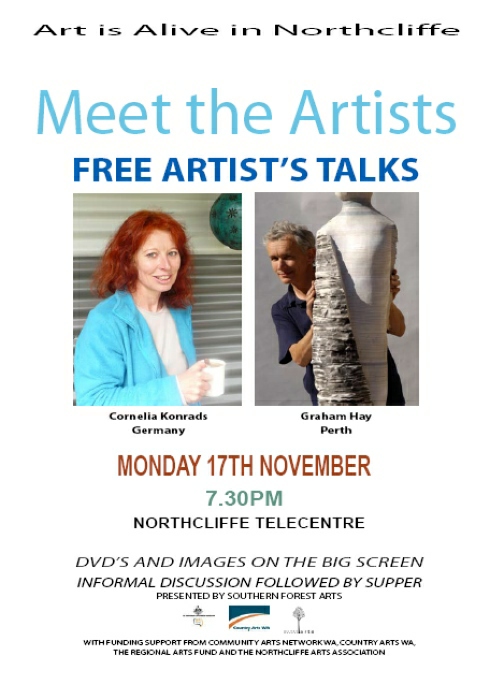
On the evening of Monday 17 November 2008, Graham Hay and international Artist Cornelia Konrads (Germany) gave a talk about their new sculptures in the Southern Forest Sculpture Walk.
|
|
|
Can you spot my sculpture in the forest, during this quick 2 minute video?
|
Concept - Graham Hay
Five tall, thin compressed paper digits emerging out of the ground suggestive of supportive, nurture, hold delicately within the palm, echoing the tree stumps in the area, natural yet processed, durable yet fallible. Making paper back into an artificial wood will obviously conserve wood by recycling a waste material, and return the paper (wood fibre) back into the natural environment. Hopefully this will inspire others to recycle paper into art and other functional items. More subtlety the work may encourage us to reconsider the growing excessive use of “paperwork” in our jobs and homes. Hopefully we will try other more informal ways to communicate, organise ourselves and others, and shape behaviour. Other thoughts came to mind of the whole process of using "culture" to very slowly alter information, and large organisations. Within art discourses, this work may sit within BioArt or Generative Art. |
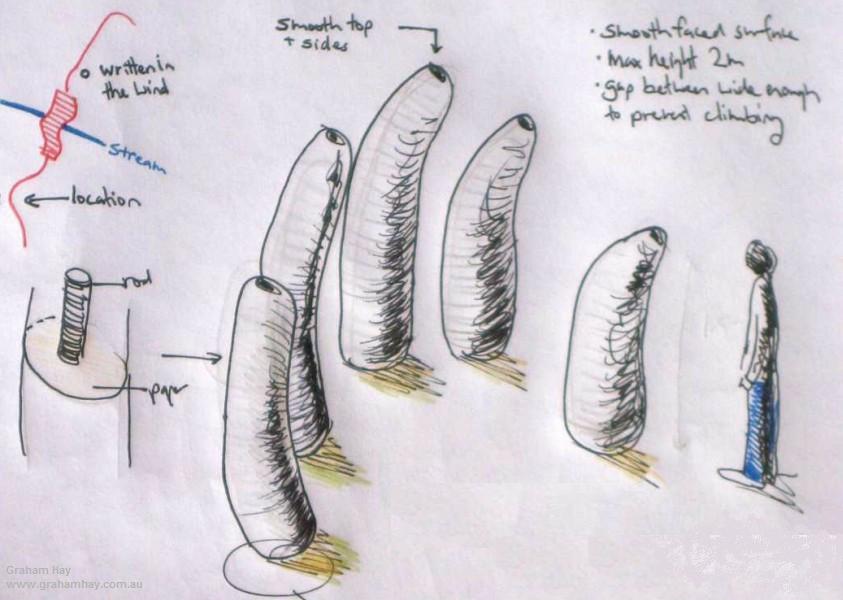
Graham's initial plan for the living sculpture.
|
|
All about the Fungi
This sculpture will attract attention because it is made from paper. Then slowly the fungi aspect of the work emerges, raising public awareness of the key roles of fungi. Fungi are the often overlooked but necessary "out of sight" underground support systems for Australia’s native flora and fauna. I contacted Dr Neale Bougher, Mycologist/Senior Research Scientist, with the Department of Environment and Conservation, who recommended and provided Scarlet Bracket Fungus spores, which is a non-toxic, native to WA, wood eating fungus (see page N-8 of on-line book at www.fungiperth.org.au). During construction of a compressed paper sculpture for the 2008 City of Melville Sculptural Walk, the spores was placed inside it. Unfortunately the paper was so tightly compressed that despite lying unsealed in water for several months, water and oxygen did not penetrate the sculpture to stimulate the spores. Based upon this conclusion, Dr Bougher recommended I contact Donna Franklin, Fungi and bacteria Artist and Tutor at Edith Cowan University. He also told me that Scarlet Bracket Fungus is native to all parts of south-west including the Northcliffe area and suggested ways to encourage good growth and "fruiting". |
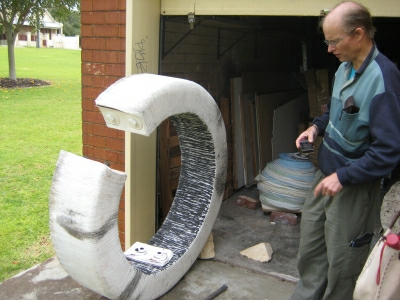
Dr Neale Bougher inspecting the first attempt to grow the fungi on the 2008 City of Melville Sculptural Walk work. Photo: Graham Hay
|
|
Collaborative Contribution – Donna Franklin
The living component (scarlet bracket fungus) has been supplied and grown by Donna Franklin. This is based on her previous research with the species in art / science artworks such as the living fungi dress ‘Fibre Reactive’, created during her Masters of Art studies at The School of Contemporary Arts, Edith Cowan University and artist residency at SymbioticA: The Centre for Excellence in Biological Arts, The University of Western Australia. This artistic contribution has been made especially for Graham Hay’s artwork for this particular project in the Northcliffe, South West Sculpture Walk 2008. Special Thanks to the Faculty of Natural and Agricultural Sciences, The University of Western Australia. |
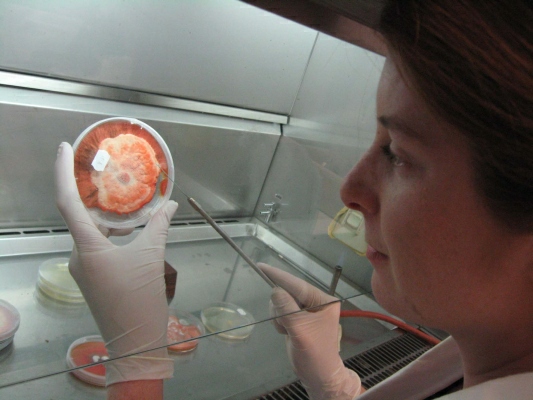
Donna Franklin with Cultures in Lab 2008, photo: Donna Franklin.
|
|
Construction
Final site selection for the sculpture was made with Fiona Sinclar, commission Project Coordinator for Southern Forest Arts (Inc.), on Monday 3 November. Roy Moss has provided some great advise on structural aspects of the sculptures, and welded the joining nuts to the top rods. Thanks also to Sid Asepkus who quickly organised site works and the pouring of the concrete foundations. This was undertaken by Jason Tatlor and Doug over the 8-9 November weekend. The paper parts I had prepared in the Robertson Park Artists Studio, were threaded onto the rods in the concrete foundations, during 16 -18 November 2008. For a few weeks after installation Anne Sepkus sprayed a water and nutrient mix onto the paper and wrapped it in plastic, so to feed and protect it. |
A short slideshow of the construction of the living sculpture.
|
"As you will see we are getting some moulds on the sculpture, they are looking quite colorful though it is mostly a black mould,"said Anne in her email. "I'm hoping that the patches of orange are related to the fungi spore. They are growing mostly near the inner bend, I haven't seen anything at ground level. The work has settled in well and is looking more "organic" than it did at first"(email: Saturday, 24 October, 2009 10:12:47 PM GMT +08:00 Perth). Dr Neale Bougher, Mycologist/Senior Research Scientist, with the Department of Environment and Conservation states that
"The photos show that the orange fungus has grown. If there are sufficient reserves of nutrients within the sculpture to last until the next wet season, the orange fungus may begin to produce fruiting structures. It will depend on the amount of particularly woody material left inside. The black growths are most likely only mould fungi growing primarily on the paper and they will not produce large structures" |
Do plan to visit the Northcliffe Forest Sculpture/ Understory Walk, and see this and many other sculptures, all hidden within different natural forests.
click here for directions and more information. Why not email me your recent photos of the sculptures and fungi growing? (I'll add them here and credit you) Or bookmark this page, and visit again, to see how the fungi has grown over time? |
