HQ Public Art Project for Town of Vincent
Background.Three experienced artists (Alexander Hayes, Graham Hay , Peter Zappa ) designed the artworks with the help of 6 young artists. They were Makiah Coleman , Emma Fletcher, Parmon Hill – Martdee, Shane Janicki , Belinda Turner and Graham Withey.
Background
|
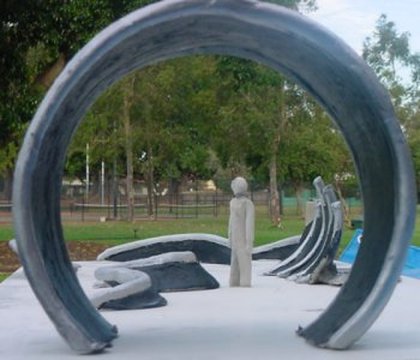
A number of workshops in late 2001 developed ideas and small paperclay models. Ideas written down at these early workshops included:
"Sense of place, freedom, social acceptance, beauty, sensory movement, interactive, sexy, bubbles, transport, trains, bikes, skates-blades, scooters, friendships, spiritual, ritual, symbol, ethnic.." A large number of materials from which to build the art were recorded, ranging from plastic and chicken wire, through to concrete and steel. A series of hands-on workshops produced a large number of drawings and small paperclay models. Common themes across most of the work were the wheel, the curve and the human body. Alex Hayes, Graham Hay and Peter Zappa then took the common physical elements and themes and over three further workshops distilled the models down to three models. The Wheel entrance idea emerged as a way to create a psychological entry statement which would link the other three artworks together. The intention in using common materials, scale and so shapes across the drinking fountains, skateable sculptures, seat and wheel was to create a unifying tone which would enable mental linkages to be created between each work. It also signifies a common origin. |
The Wheel (deleted from project)
|
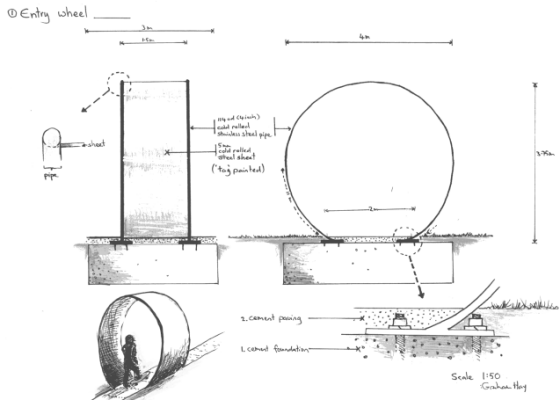
The Wheel is the entry statement designating the entrance to the HQ "space".
It creates a psychological transitional point between the city and the HQ "space". The wheel is the key to personal freedom, and the HQ facility (Whether skateboarding, roller-blade or MBX). Our whole society is based upon the wheel, vehicles and physical mobility. The wheel or circle is a powerfully historical symbol. Young people coming to HQ join the large "circle" of those who use the facility. The circle is also a symbol of completeness. |
|
The Drinking Water Fountains
|
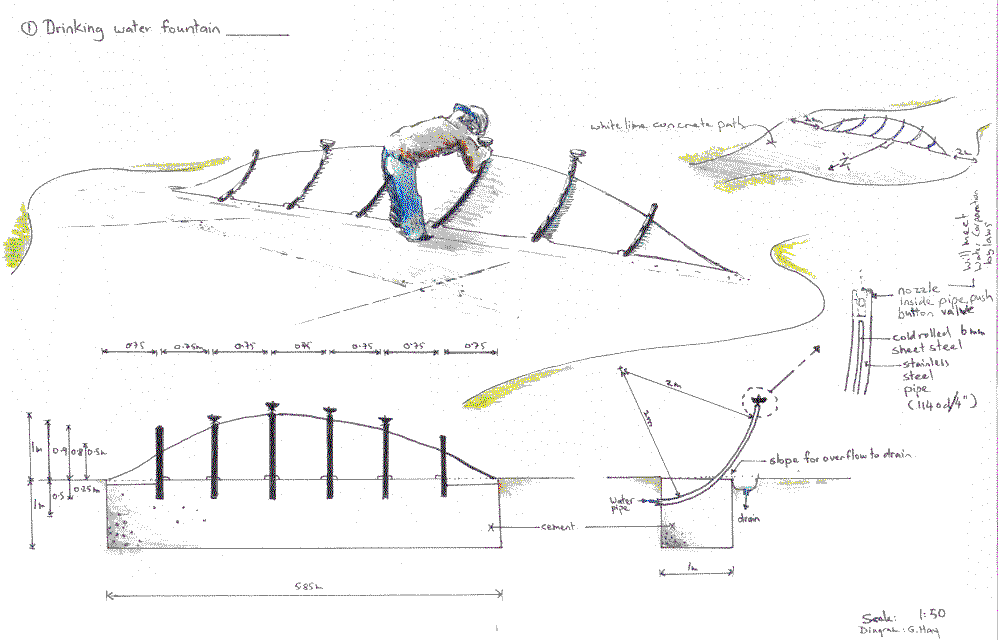
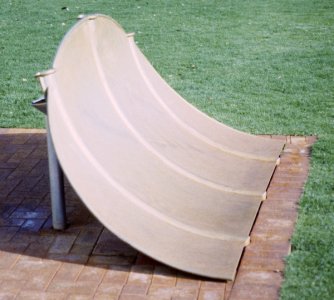
The drinking water fountains echo the circle symbolism in that they are made from curved sections.
More than one fountain is provided so that many can drink at the same time, symbolising equality. The ideas of democracy physically illustrated. The fountains are at different heights, recognising that those coming to HQ are different sizes, different ages, and from different backgrounds. |
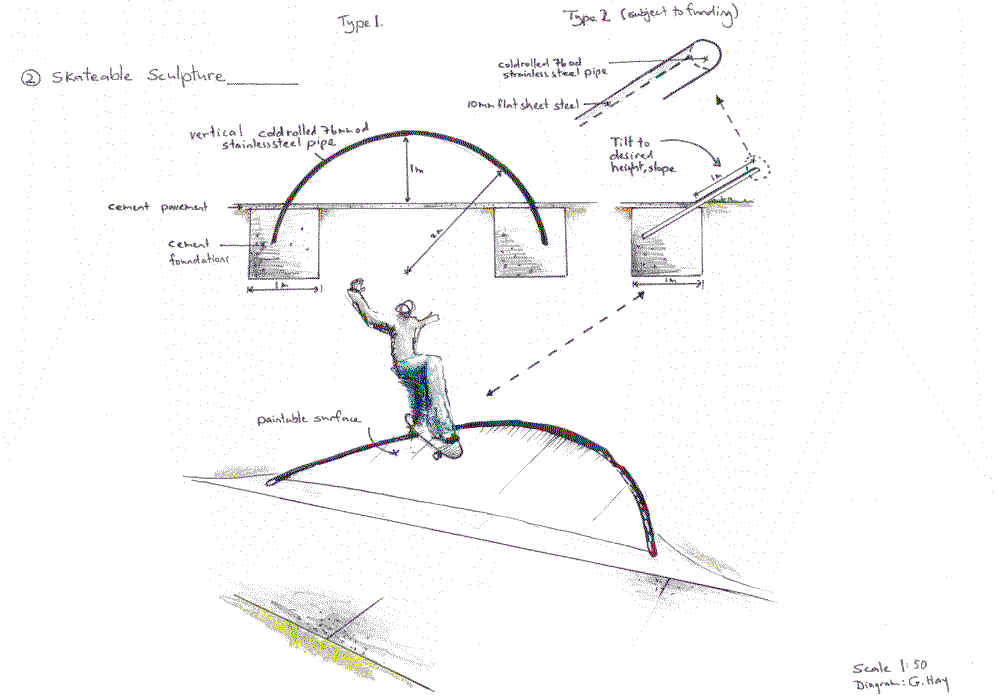
The Skateable Sculptures. (deleted from project)
|
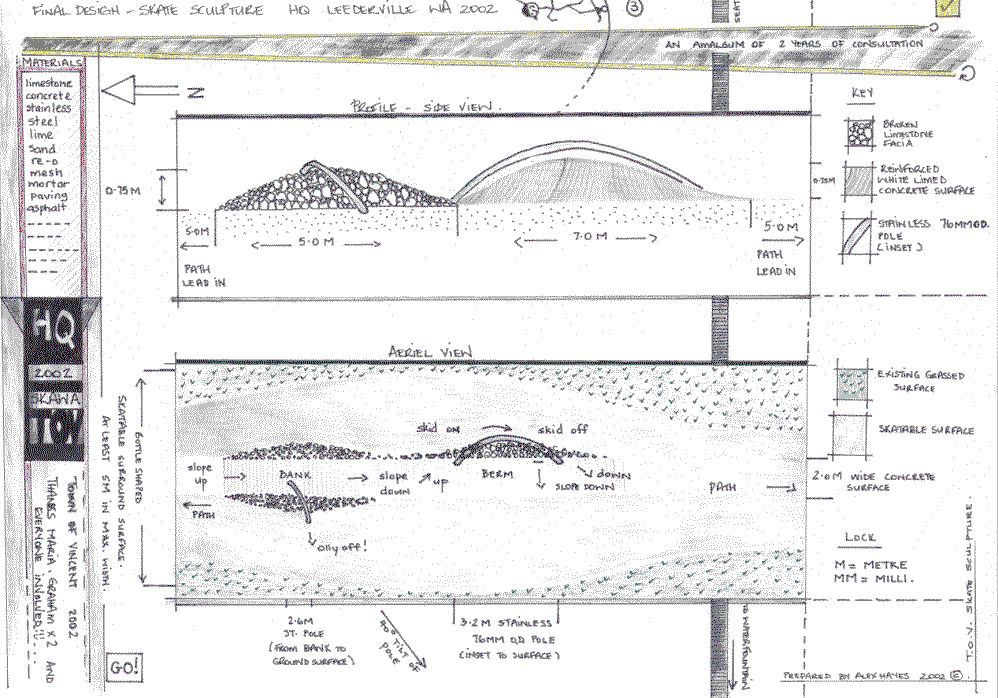
The idea is that HQ will provide a different experience, depending upon what part you use and the direction and speed at which you approach it.
The sculptures prepare you for your HQ experience. |
|
|
Each of the skateable sculptures also uses parts of the circle.
However because each sculpture is at a different height and slope, then each provides a different experience. |
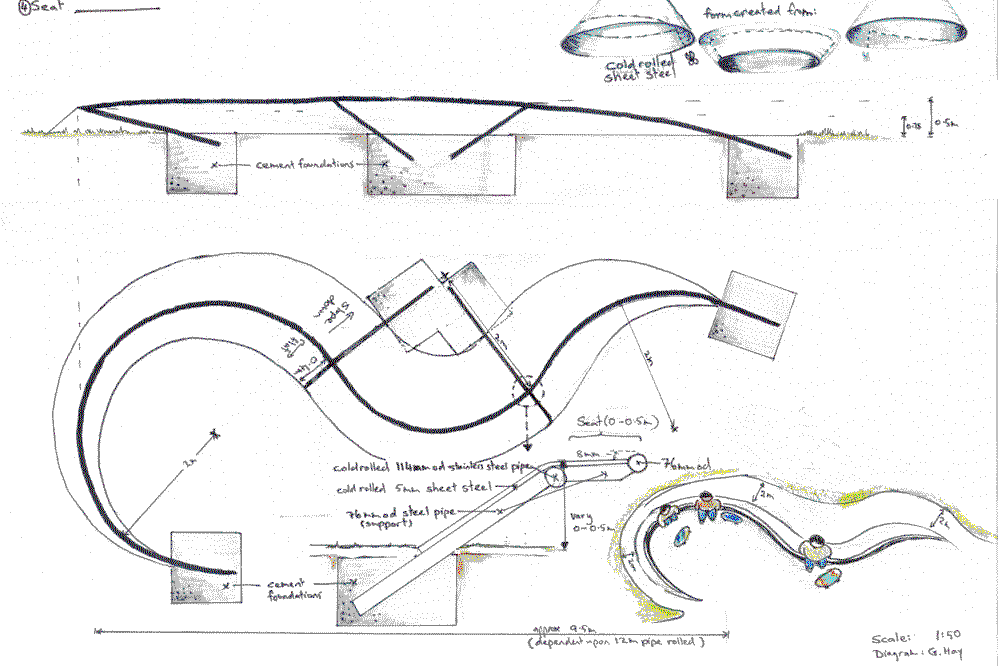
The Seat
|
The seat has also elements of the circle in it. It is an unravelled or incomplete circle.
It provides a place for people to wait or meet. It is the beginning of a circle of friends. Where new friends and old gather before going on. Fragments of circles meet at the seat. Hopefully they will leave at the end of the day as new friends and wider circles. |
|
The Final Work
|
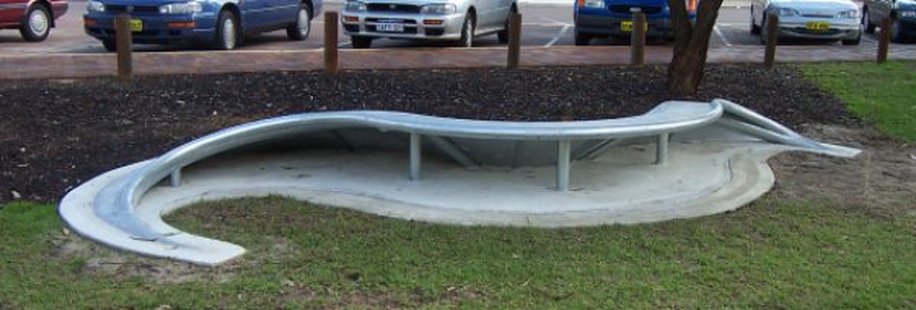
Sheet metal was chosen due to its durability and hardwearing nature (ie skateboard friendly). The surface was to be untreated so that it could be "tagged", plastered with notices, and to leave open the possibility of the site as a site for future murals. Steel pipe was used because of its smooth edges, its durability and hard wearing nature.
In October 2003 the final sculptural seat and water drinking fountains were installed in the redesigned Oxford Street Reserve. Due to increased public liability concerns at that time, the Town of Vincent did not pave the area around both works, preventing skateboarders from rolling/ /sliding / jumping over the works. |
Postscript:
The sculptural seats were designed to be skateboard friendly.
After the park was renovated in 2015, the artists were not consulted before the work was moved to a isolated back corner, again in a location preventing skating on them.
The surface is untreated so that to leave open the possibility of future murals/Steet art. You are invited to create some great art on them, as originally designed.
The sculptural seats were designed to be skateboard friendly.
After the park was renovated in 2015, the artists were not consulted before the work was moved to a isolated back corner, again in a location preventing skating on them.
The surface is untreated so that to leave open the possibility of future murals/Steet art. You are invited to create some great art on them, as originally designed.
Read more about the project in Hay, G. (2002), A skate able sculpture: using paperclay as a design material, Pottery in Australia, 41, (1), 42-43.
Click here to email comments to all artists
Click here to email comments to all artists
