Reproduced, with permission (Editor email 4/4/2002), copy of Hay, G.,(2002) A skate able sculpture, Pottery in Australia, 41, (1), 42-43
A skateable sculpture
Using paperclay as a design material
by Graham Hay
A public art project, by the Town of Vincent in Western Australia, provided an unusual opportunity for using paperclay as a design material. The project, a skateable sculpture, seat and a drinking water fountain, is to be located in a park adjacent to Headquarters, an inner city youth facility.
THE PROCESS
The stated aim was to enable young people to work alongside experienced artists on the $69,000 public art project. The young artists were chosen from a large number of applicants. They ranged in age from 14 to 25 years, with diverse backgrounds, talents and skills. The experienced artists worked with them to facilitate public workshops to develop design ideas.
Initial workshops developed the key ideas and themes. Further hands-on workshops saw the young artists; Makiah Copeman, Emma Fletcher, Parmon Hill - Martdee, Shane Janicki, Belinda Turner and Graham Withey produce a large number of drawings and paperclay models.
The young artists used paperclay to quickly translate their ideas into 3D models. Delicate dry parts and plastic paperclay was easily combined and re-combined to produce models for discussion and refinement. Unlike traditional clay, breaks in the dry paperclay were quickly repaired and cracking less prevalent. Previous clay experience was not a prerequisite as the paperclay was such an easy material to work.
The experienced artists Alex Hayes, Peter Zappa and myself then distilled the common elements down to four designs. Further discussions with the young artists resulted in more refined designs closer to the young artists intentions. Shane Janicki then converted the final design into CAD plans for the Town.
Digital photographs and scanned designs were loaded onto the artist's and Town of Vincent website to stimulate public interest, discussion and feedback.
THE DESIGNS
While draft models were quickly thrown together to illustrate ideas, it took full-scale drawings on newsprint to check angles, curves and proportions relative to various sized people. Then sections were carefully made in paperclay, in a similar manner to which the final pieces would be "cold-rolled" in a steel factory (the experienced artists visited a factory to view the materials and processes to be used, their limitations and estimated costs). Once the paperclay sections were bone dry, they were joined using paperclay slip. Corrections and refinements were as simple as breaking off the offending part and replacing it with new dry or soft parts. It was the interplay between the two and three dimension drafts, which enabled many problems to be solved in simple ways. In retrospect, it was surprising how easily the "kitset" construction techniques used in paperclay translated across to planning for metalwork construction.
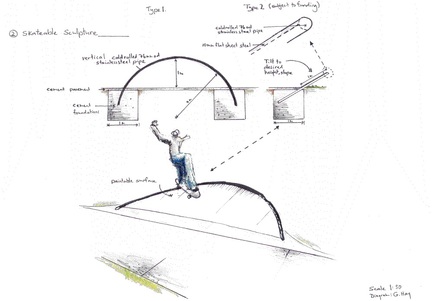
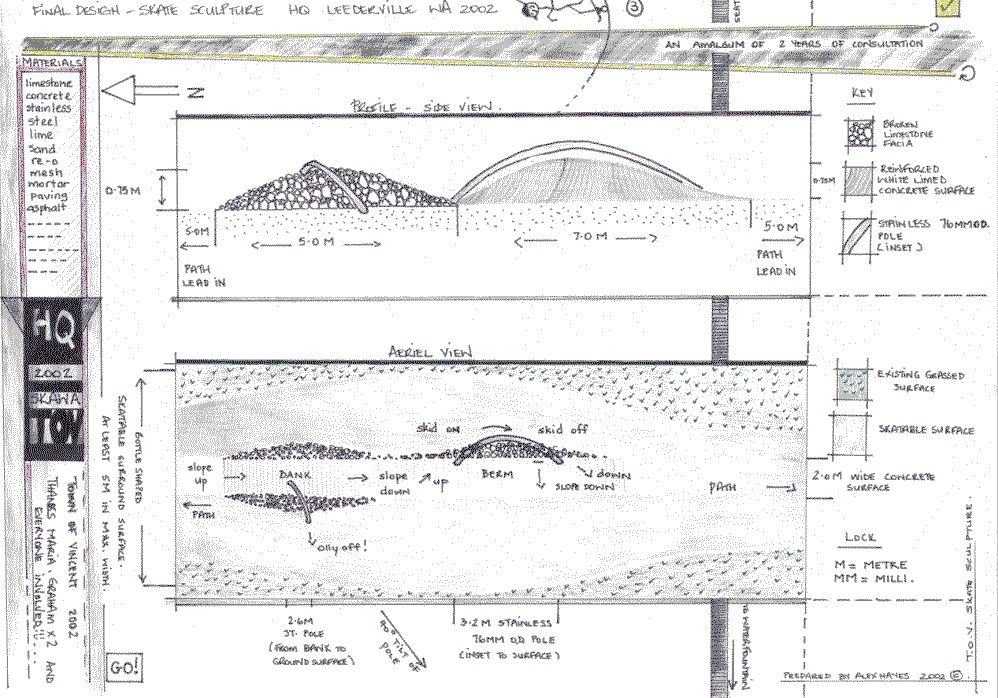
Common materials, scale and curves unify the final three designs. Sheet metal is to be used, as it is smooth and hardwearing, particularly after exposure to very high skateboard traffic. The surfaces will be untreated so that they can be "tagged", used as a billboard, or later decorated. Stainless steel pipe will be used on all edges to provide non-corrosive, hardwearing and smooth edges.
The drinking water fountain will contain multiple spouts at different heights. This caters for differences in sizes and enables more than one person to drink at the same time, suggesting inclusive physical equality (no queues or preferred age/size). Each of the skateable sculptures is at a different height and slope, providing multiple experiences, depending upon direction and speed at which they are approached.
The seat is an unravelled or incomplete circle, providing a place for people to meet and watch the action. It is suggestive of a reclining form, provides different height seating places and has skateable surfaces.
The bases of the three public artworks are to lowered into large "tubs" of fresh concrete, their position and angles fine-tuned, before waiting until the concrete sets. Concrete paving would then be poured around the artworks to provide a smooth rolling and walking surface.
We look forward with anticipation to seeing our collective designs finally converted into physical artworks and their installation.
Town of Vincent Youth Officer Maria Miceli coordinated the project and the Australia Council funded the design development stage.
The designs are currently pending formal approval by the Town of Vincent, which has already committed itself to funding the construction and installation of the artwork.
by Graham Hay
A public art project, by the Town of Vincent in Western Australia, provided an unusual opportunity for using paperclay as a design material. The project, a skateable sculpture, seat and a drinking water fountain, is to be located in a park adjacent to Headquarters, an inner city youth facility.
THE PROCESS
The stated aim was to enable young people to work alongside experienced artists on the $69,000 public art project. The young artists were chosen from a large number of applicants. They ranged in age from 14 to 25 years, with diverse backgrounds, talents and skills. The experienced artists worked with them to facilitate public workshops to develop design ideas.
Initial workshops developed the key ideas and themes. Further hands-on workshops saw the young artists; Makiah Copeman, Emma Fletcher, Parmon Hill - Martdee, Shane Janicki, Belinda Turner and Graham Withey produce a large number of drawings and paperclay models.
The young artists used paperclay to quickly translate their ideas into 3D models. Delicate dry parts and plastic paperclay was easily combined and re-combined to produce models for discussion and refinement. Unlike traditional clay, breaks in the dry paperclay were quickly repaired and cracking less prevalent. Previous clay experience was not a prerequisite as the paperclay was such an easy material to work.
The experienced artists Alex Hayes, Peter Zappa and myself then distilled the common elements down to four designs. Further discussions with the young artists resulted in more refined designs closer to the young artists intentions. Shane Janicki then converted the final design into CAD plans for the Town.
Digital photographs and scanned designs were loaded onto the artist's and Town of Vincent website to stimulate public interest, discussion and feedback.
THE DESIGNS
While draft models were quickly thrown together to illustrate ideas, it took full-scale drawings on newsprint to check angles, curves and proportions relative to various sized people. Then sections were carefully made in paperclay, in a similar manner to which the final pieces would be "cold-rolled" in a steel factory (the experienced artists visited a factory to view the materials and processes to be used, their limitations and estimated costs). Once the paperclay sections were bone dry, they were joined using paperclay slip. Corrections and refinements were as simple as breaking off the offending part and replacing it with new dry or soft parts. It was the interplay between the two and three dimension drafts, which enabled many problems to be solved in simple ways. In retrospect, it was surprising how easily the "kitset" construction techniques used in paperclay translated across to planning for metalwork construction.
Common materials, scale and curves unify the final three designs. Sheet metal is to be used, as it is smooth and hardwearing, particularly after exposure to very high skateboard traffic. The surfaces will be untreated so that they can be "tagged", used as a billboard, or later decorated. Stainless steel pipe will be used on all edges to provide non-corrosive, hardwearing and smooth edges.
The drinking water fountain will contain multiple spouts at different heights. This caters for differences in sizes and enables more than one person to drink at the same time, suggesting inclusive physical equality (no queues or preferred age/size). Each of the skateable sculptures is at a different height and slope, providing multiple experiences, depending upon direction and speed at which they are approached.
The seat is an unravelled or incomplete circle, providing a place for people to meet and watch the action. It is suggestive of a reclining form, provides different height seating places and has skateable surfaces.
The bases of the three public artworks are to lowered into large "tubs" of fresh concrete, their position and angles fine-tuned, before waiting until the concrete sets. Concrete paving would then be poured around the artworks to provide a smooth rolling and walking surface.
We look forward with anticipation to seeing our collective designs finally converted into physical artworks and their installation.
Town of Vincent Youth Officer Maria Miceli coordinated the project and the Australia Council funded the design development stage.
The designs are currently pending formal approval by the Town of Vincent, which has already committed itself to funding the construction and installation of the artwork.
|
|
Editor Postscript: The above two, of five designs, were initially rejected by the Town of Vincent. However, two designs were endorsed by the Town. See links below for all designs and final works.
For more information, designs and images of the installed work visit www.grahamhay.com.au/hq.html
For extensive information on paper clay visit www.grahamhay.com.au/paperclay.html
More paper clay articles? click here.
For more information, designs and images of the installed work visit www.grahamhay.com.au/hq.html
For extensive information on paper clay visit www.grahamhay.com.au/paperclay.html
More paper clay articles? click here.
Reproduced, with permission (Editor email 4/4/2002), copy of Hay, G.,(2002) A skate able sculpture, Pottery in Australia, 41, (1), 42-43
